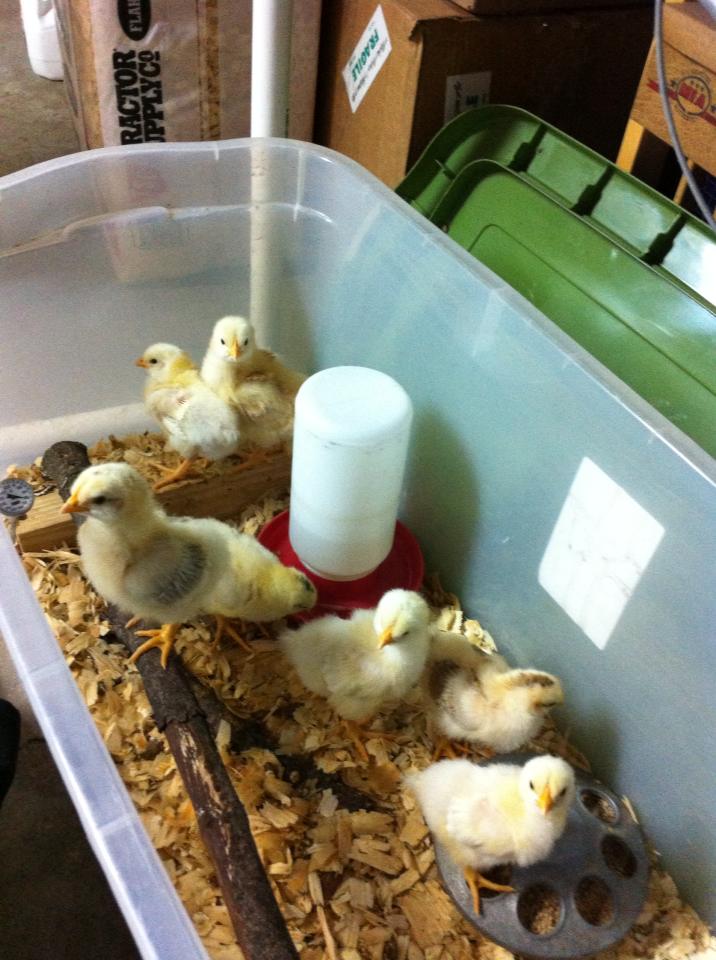
Our used-to-be neighbor, whom we miss very much since we moved, finally got chickens. They were hatched in November 2013.
They are mighty cute, and almost worthy of the palatial coop her husband built.
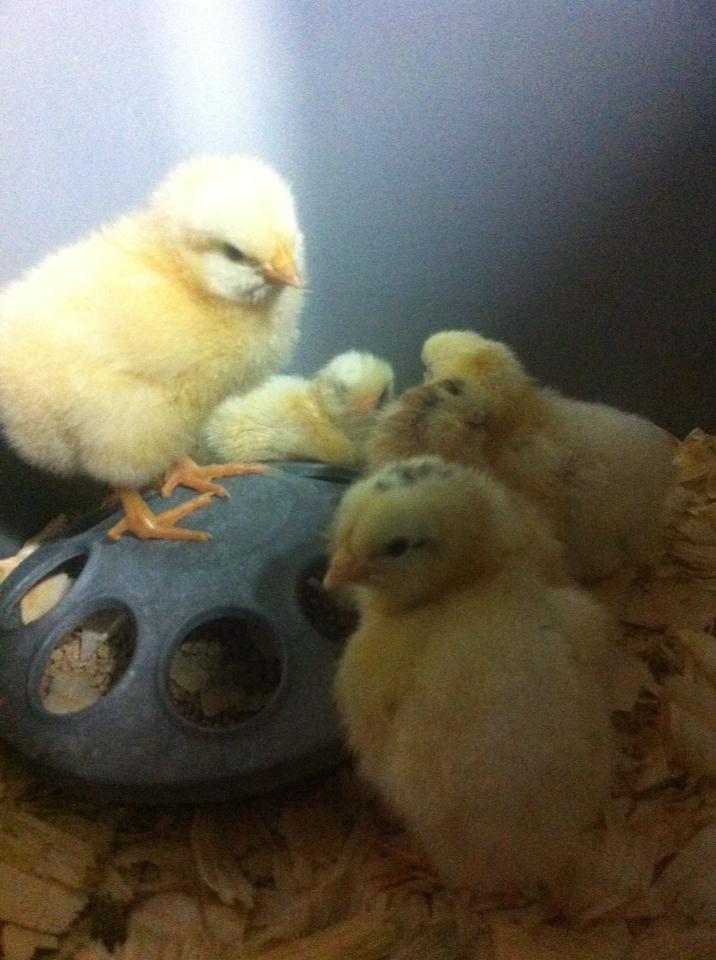

Our used-to-be neighbor, whom we miss very much since we moved, finally got chickens. They were hatched in November 2013.
They are mighty cute, and almost worthy of the palatial coop her husband built.

I had never considered just how chickens might possibly escalate.
We’ve been very excited about the prospect of having chickens next door. The husband-type component of the world’s best neighbors is building a great-looking chicken coop. So far it’s plywood and a good-looking metal roof.
Here it is at an earlier stage.
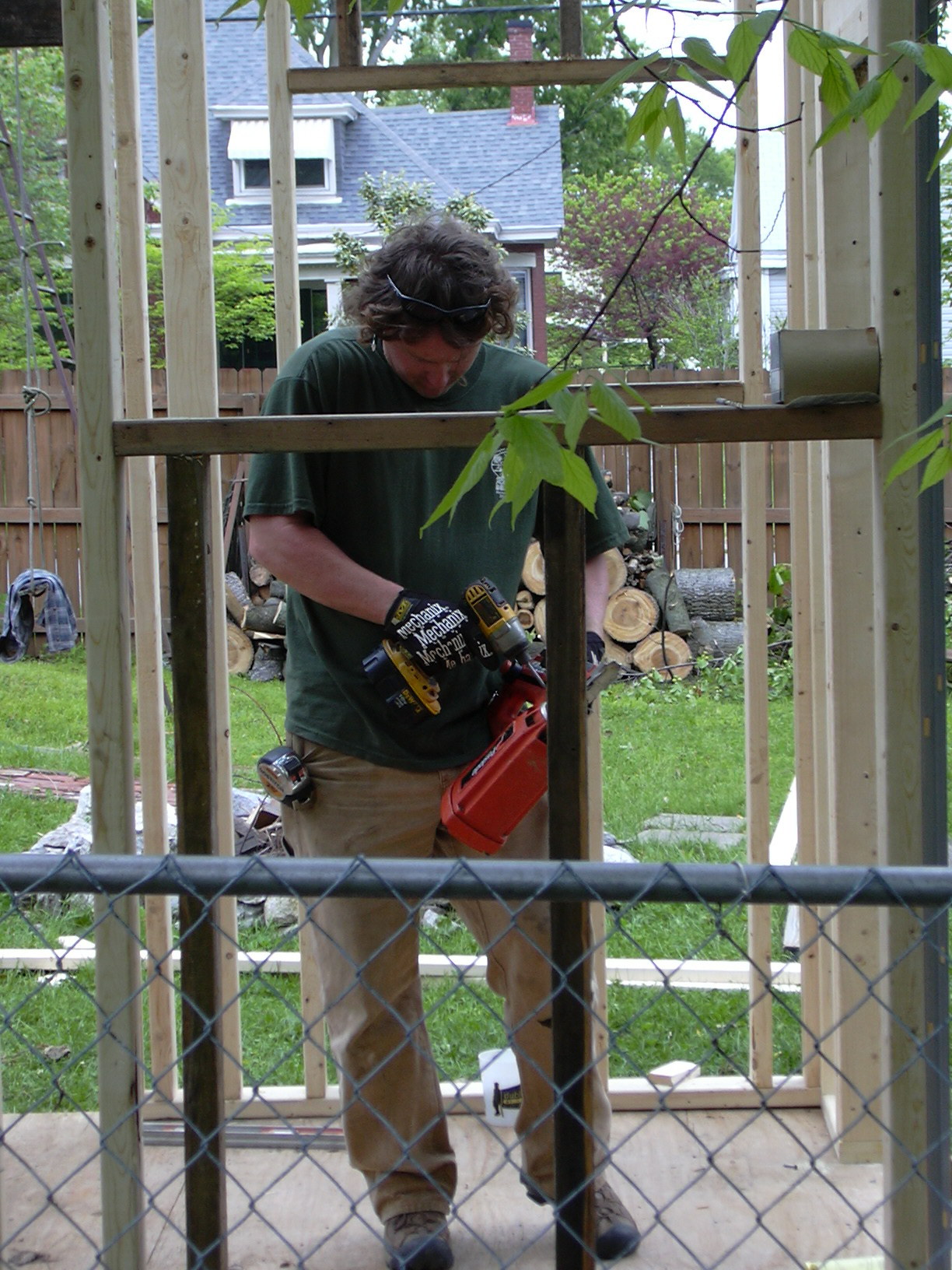
First runner-up in the Hambrick Avenue Crazy Husband Contest
We figure next door is just about the perfect distance to enjoy chickens vicariously. I expect they’ll hop the fence every so often, but the frizzles, silkies, and pekins Amanda is thinking about getting — chickens with a high, an extremely high cuteness factor — are not great flyers.
Therefore, this situation promises to be perfect for us. Like having nieces and nephews — close enough to enjoy, but not saddled to you for life.
I had never considered the possibility of a chicken incursion into my house. Until now.
These photos, from Farmhouse38, seem to document a full-scale chicken invasion.

Apparently, these bold marauders do not fear guard dogs.
You’ll be glad to know that this invasion was thwarted . . . . For now.
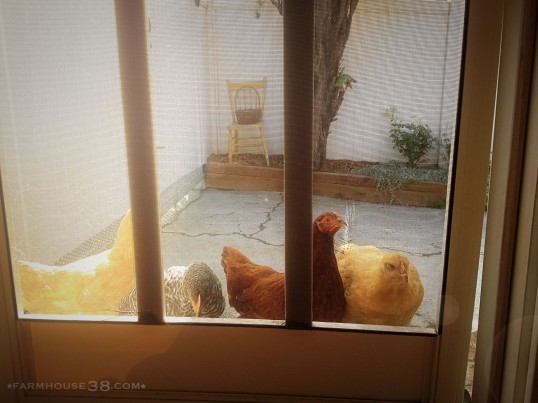
From Farmhouse38
Then again, some people actually encourage their chickens to enter the house: thus, the invention of chicken diapers. 
Friends, I am not making this up. This photo is from the “chicken diapers” page of My Pet Chicken, an emporium supplying both common and exotic fowl and paraphernalia for all your pet chicken needs.
There is also a site called ChickenDiapers.com. At this website, chicken diapers are available in fourteen colors, black and white, a rainbow print, and one called “Woodland,” which looks very much like Mossy Oak.
On thorns
I love the fact that roses have thorns. I think their silky-soft petals, gorgeous colors, and sensuous scents coupled with razor-sharp, bloodthirsty thorns make a piquant combination. But not everybody feels the way I do. So here are some recommendations for people who can’t hack the thorns.
There are some really good roses that do not have thorns, or that don’t have many thorns, or the thorns they do have are very tiny. In fact, some are good enough to merit a share in the limited space in my yard. You can get any of these at Antique Rose Emporium, Heirloom Roses, or Petals from the Past.
Thornless roses I have grown and recommend
Shrubs
Marie Pavie
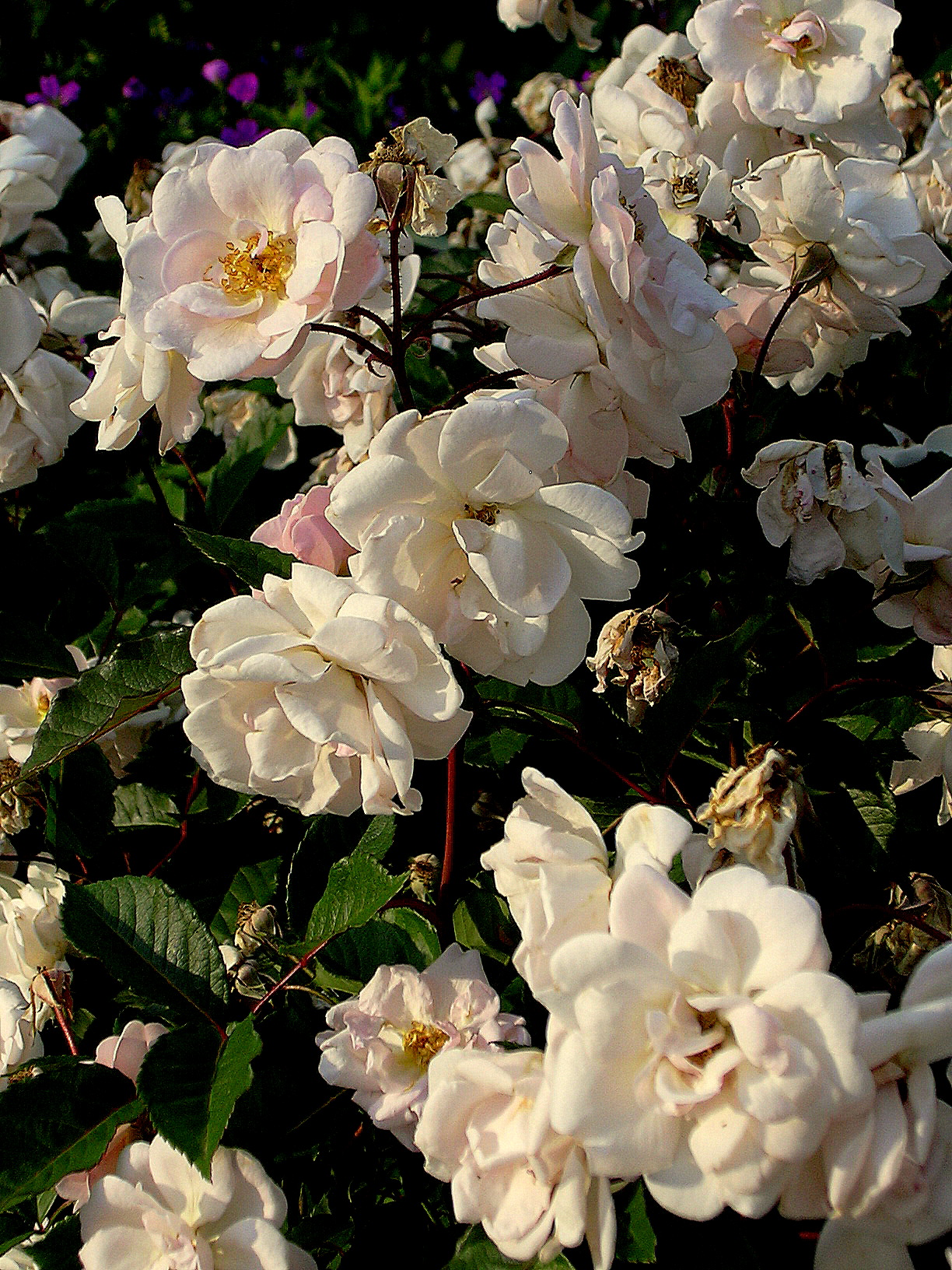
The photo above shows the flowers of Marie Pavie, a short, bushy shrub that’s always thickly covered with leaves and most of the time also covered with clusters of small pinkish-white flowers.
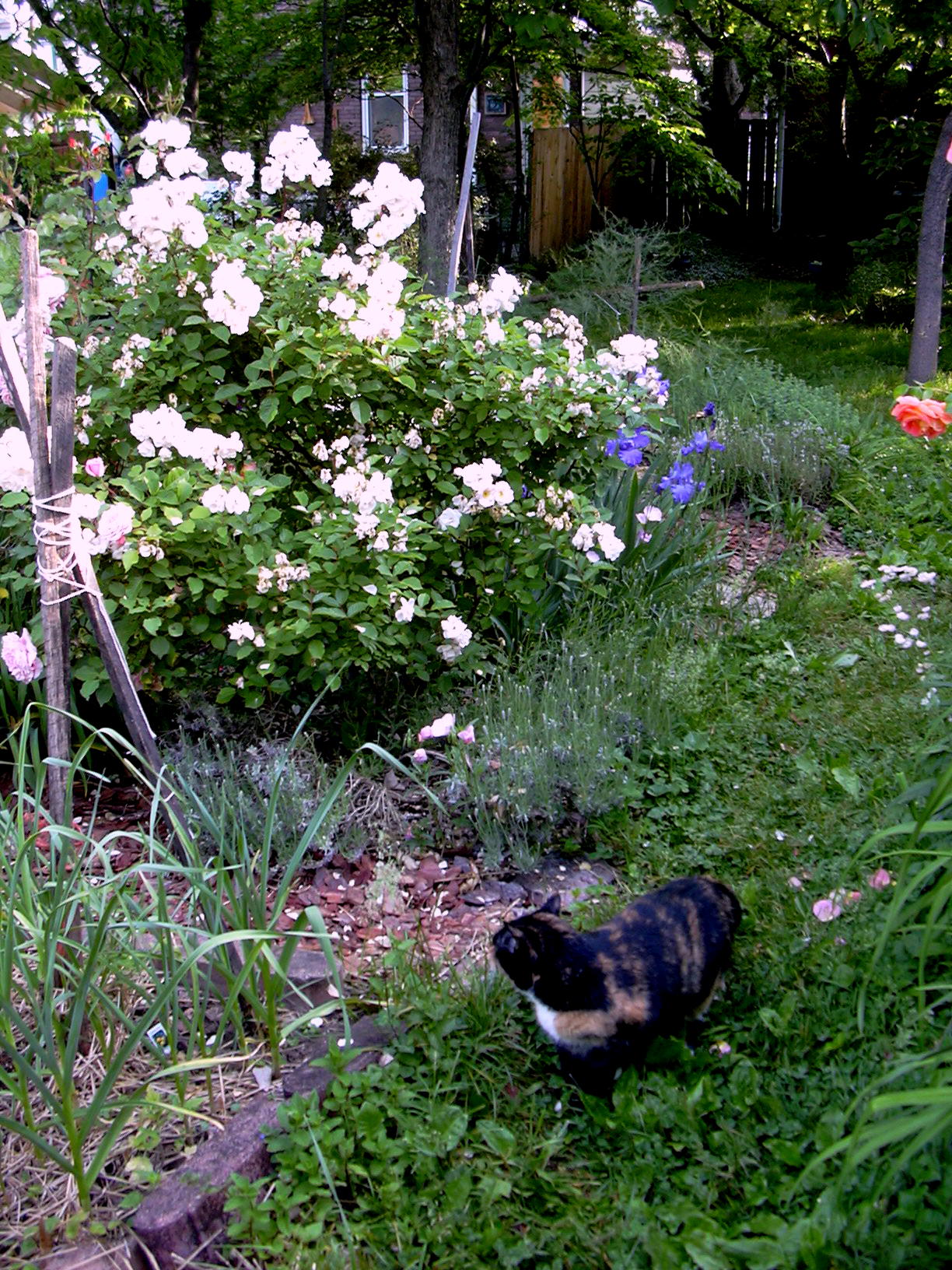
Here is another picture of a plant in my back yard, so you can see what the plant looks like. It’s about four and a half feet high and four feet wide, since I never bother to prune it to keep it at a certain size.
Nur Mahal
Nur Mahal blooms in clusters of reddish-fuchsia flowers. It grows a little bigger, maybe 5-6 feet tall unless you prune it. The header at the top of this blog is a Nur Mahal that used to be in the front yard. Nice plant, no thorns, blooms fairly constantly in the sun.
I planted this rose too close to the sidewalk and, I will confess, I accidentally killed it by moving it. It was too big and established for me to move. But I had started another plant that is in the backyard.
This is a flower cluster just starting to bloom:

This next picture shows more of the whole plant. Keep in mind this rose is planted against the northeast side of an eight-foot privacy fence, so it doesn’t get as much sun as most roses demand:

Climbers
Ghislaine de Feligonde
Yes, the golden star of my blog is also thornless. I checked. I don’t think of her as a thornless rose, but all there are are a few prickles, like the ones on a thornless raspberry, and some prickles on the back of the compound leaf stem that would likely snag your pantyhose if you brushed against them.
She is a small polyantha climber that blooms in clusters of a dozen or so multi-petaled blooms that open apricot and fade to a lemon chiffon color.
Just opened:
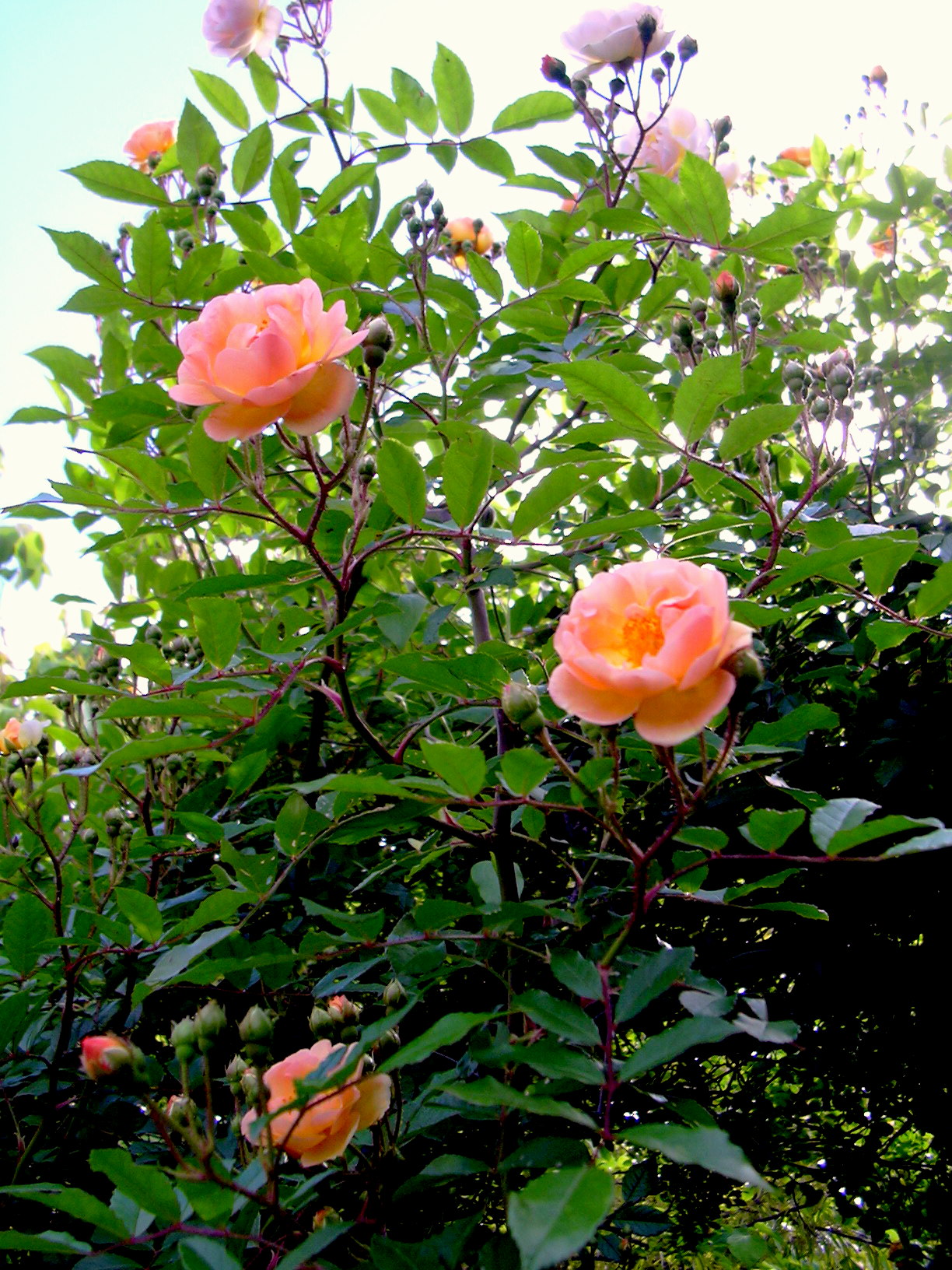
The flowers on any cluster open at different times, so the whole plant becomes a tapestry of yellow and apricot. This picture shows it best:

She’s a great plant. Does not lose many leaves to black spot or go into a pout in August.
Zephirine Drouhin
Zephirine has the most gorgeous smell and the most beautiful color of all the roses I grow. The smell is a tea rose fragrance that has lemon in it. The color is a very peculiar fuchsia that is both warm and cool at the same time. For this reason, the flowers are fantastic in arrangements, though — like all roses that make good garden plants as well as flowers, rather than “flower cows” that make long-stemmed roses on butt-ugly plants — the stems are short.
She also is thornless — really thornless. I mean, like, naked.
She is a Bourbon climber from 1870. The exotic name suggests a lovely mistress, one so gorgeous that only somebody who obtained his money very illegally could possibly afford to keep her.
This is Zephirine:
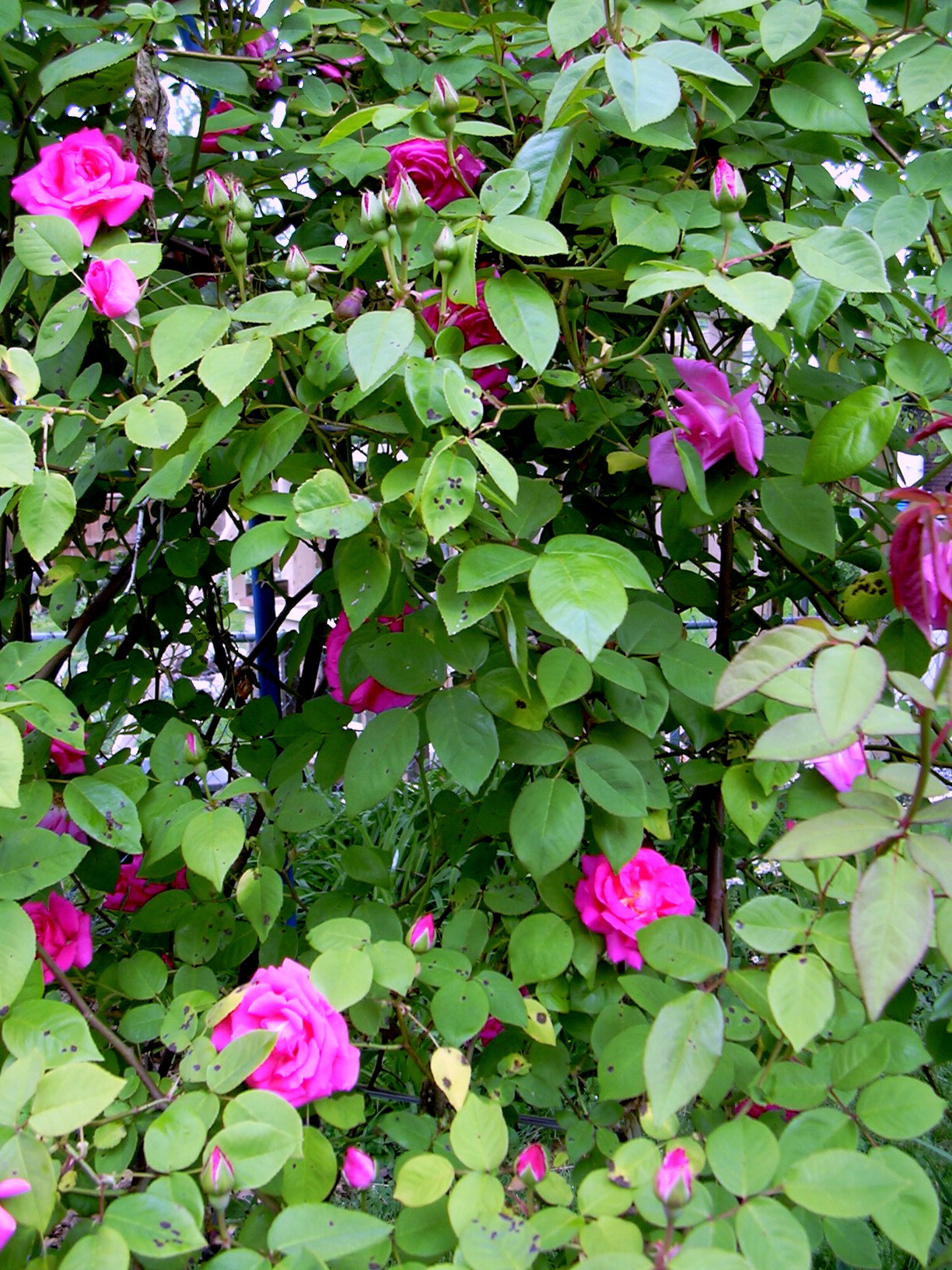
Note the black spots on the leaves. This is partly because she is now in the shade of a hackberry tree that has gotten really big. I mean, so close to the tree that she is climbing up a branch of it. Most roses will not put up with this kind of nonsense. Many will just decline and die. She merely gets some black spot, which causes leaves to yellow and then fall off, from the stress of shade. She would do better in the sun — there are three plants on a fence on Old Frankfort Pike that are constantly covered with leaves and produce more flowers because they get more sun — but is too big to move. [See “Nur Mahal” above].
During spring flush of bloom:
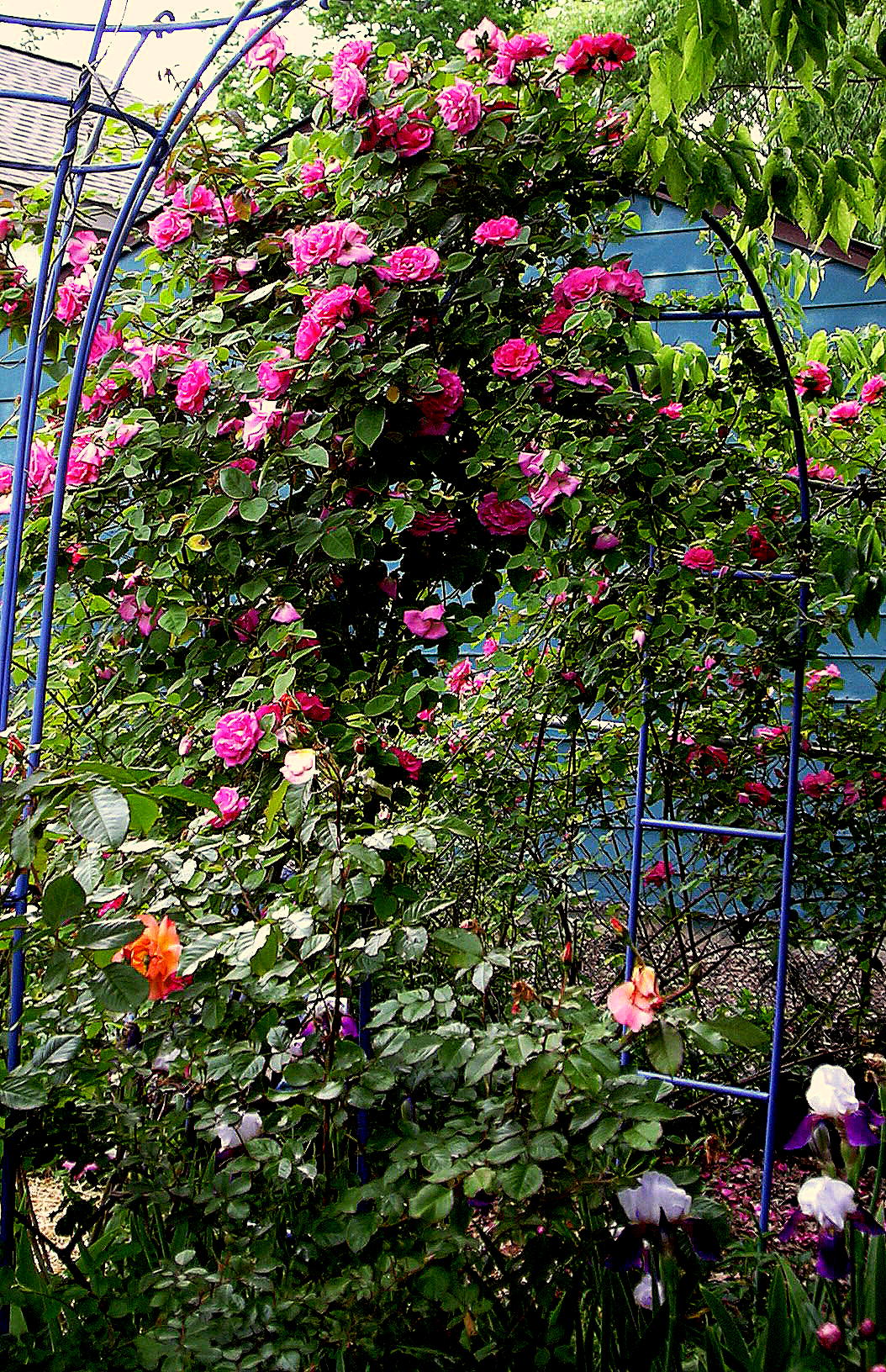
Peggy Martin
I don’t have a picture of Peggy Martin, because she is very small at this point, although blooming heartily.

Peggy Martin from arborgate.com
As you can see, she grows like a hog. The rose clearly gets BIG. And fast. Every picture I’ve seen shows a fence, trellis, arch, or other structure smothered in foliage and blossoms. Mine never stopped for breath after I planted it , but started shooting out canes blooming with clusters of one-inch pink roses.
This is the rose that survived being underwater two weeks after Katrina. The lady at Petals From the Past said she is a polyantha [like Ghislaine, with small foliage and clusters of petite flowers, although the plant may build up to get huge] and so should be fine even north of Zone Six.
Fortuniana

This rose, alas, will not grow north of Zone 7. This plant is in Austin, Texas, in Zone 8. Unlike all the other roses I’ve mentioned, this guy blooms once a year, like an azalea. Gorgeous and will get to — Wow, I’ve seen it smothering a grove of bamboo on Austin’s South 1st Street at Cardinal Lane, just north of the exit for Ben White Boulevard. It covers 12-foot bamboo over a space about 35 by 50 feet. It’s at a place called Mercury Hall, an old house used for weddings, concerts, and other events. I can’t believe I’ve never taken a picture of it in March, when it blooms, and I can’t access one online. But check out their garden anyway.
There are more thornless roses that I have grown and recommend, and once I locate the photos, I will add them to this post, so check back soon.
You might notice a lot of blue stuff in my garden. I think I first started using this band of blues when I bought the folding bistro table and chairs on the side porch. The chairs not only had molded plastic seats, but they were white — and UGLY. So I found a new primer that would paint plastic. [This was years ago. There are probably lots more options now]. Among the spray paint colors at the local hardware store was French Country Blue.
French Country Blue turned out to be a magical, glowing violet-blue. It looks great with any flower. Greens really pop against it. No other color is such a catalyst to anything else it touches. [The runner-up is chartreuse, but I get that from foliage]. What could be better?
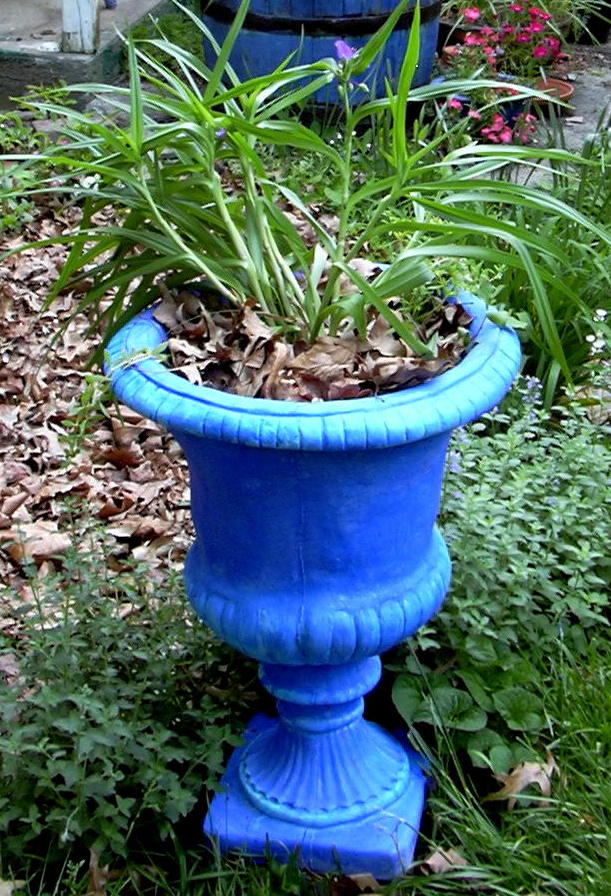
Since I can’t leave well enough alone, I found out what could be better: blue-violet with an overlay of cobalt blue, as on this urn. [The raised details are daubed turquoise]. After years of coveting a cement urn to use as a hose guard, I got one and painted it with the can of exterior violet-blue I had from a year or so ago. But in my frenzy, I hadn’t stirred the pigment in it enough, so it seemed a little bland.
Hmmm. . . .
I had the last dregs of the cobalt acrylic pigment I’d bought years ago at Michael’s just because it was so damned lovely. There was so little left in the jar I had to water it down a lot. So it dripped over the base coat just like a glaze running in the kiln. The glazelike quality echoed my new obsession with pottery and glazes.
I had painted the birdbath the same colors years ago, but did not think to make the “glazes” run.
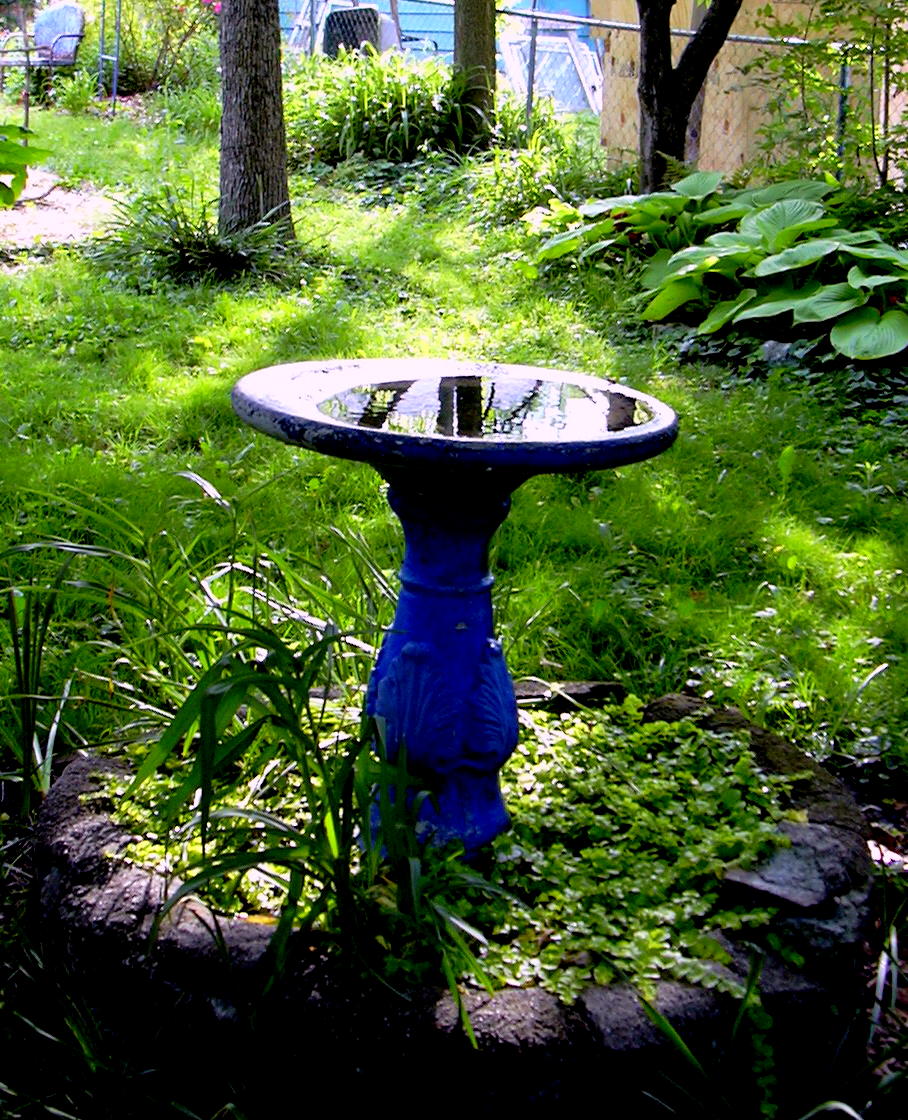
Here it is in the morning, with tradescantia (spiderworts) and a decrepit chair.
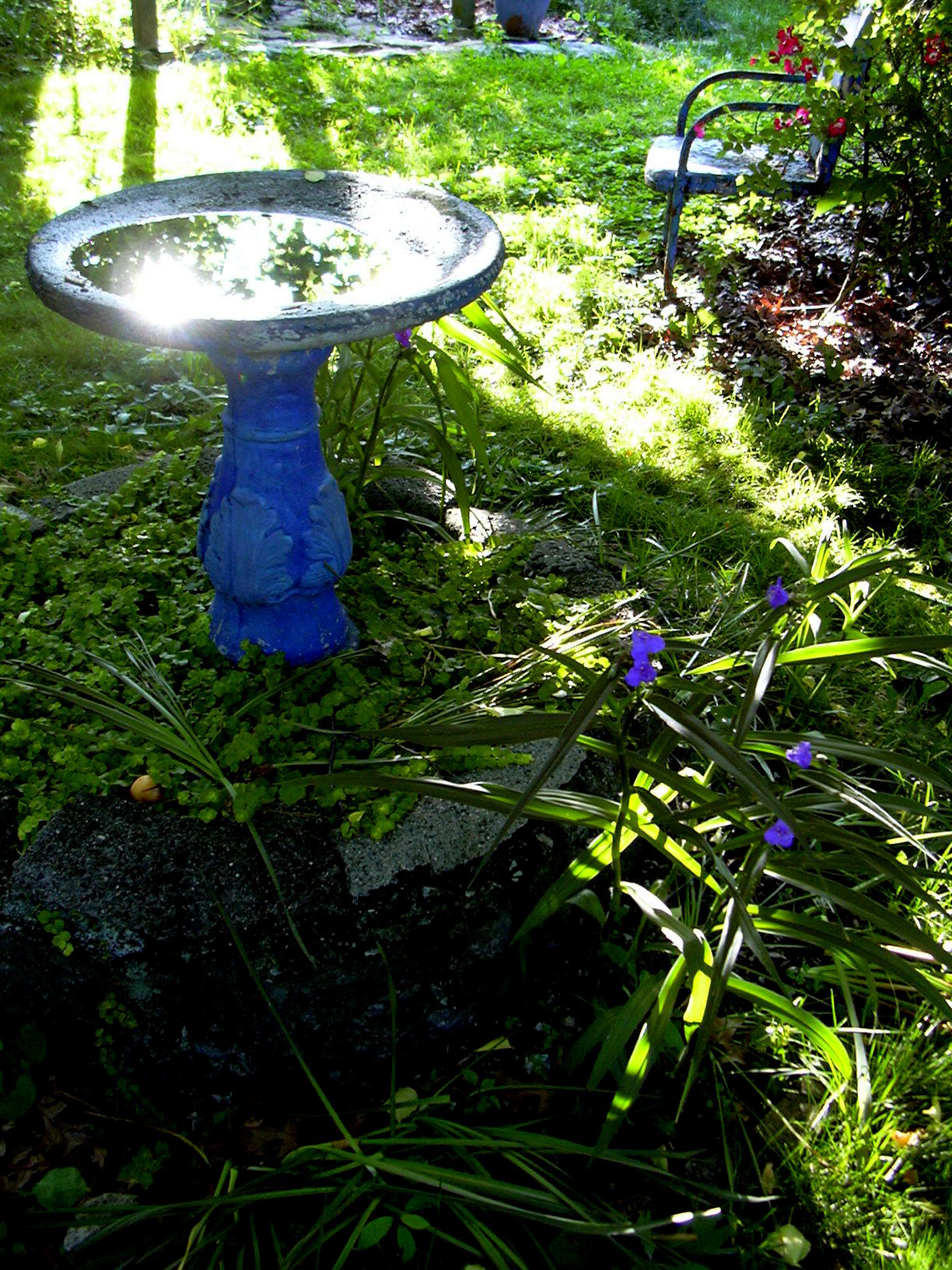
I got all wild and started painting everything blue.
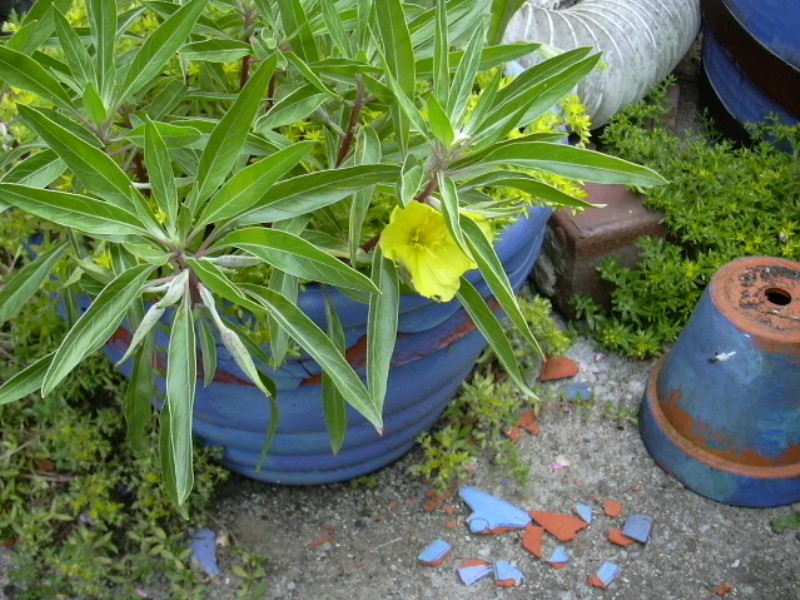
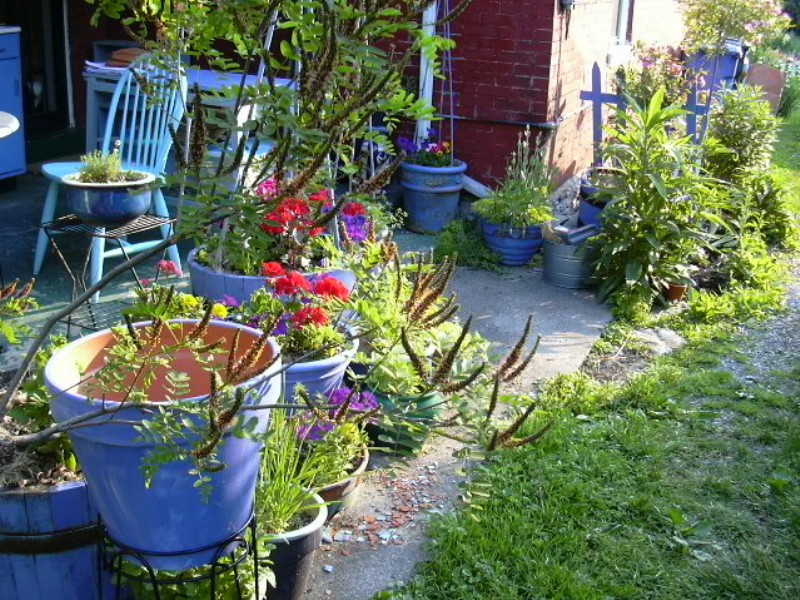
Pots, chairs, trellises, bamboo plant stakes. . . .
There are very few sure things in this life. But I guarantee you cannot go wrong with painting anything in your garden this color.
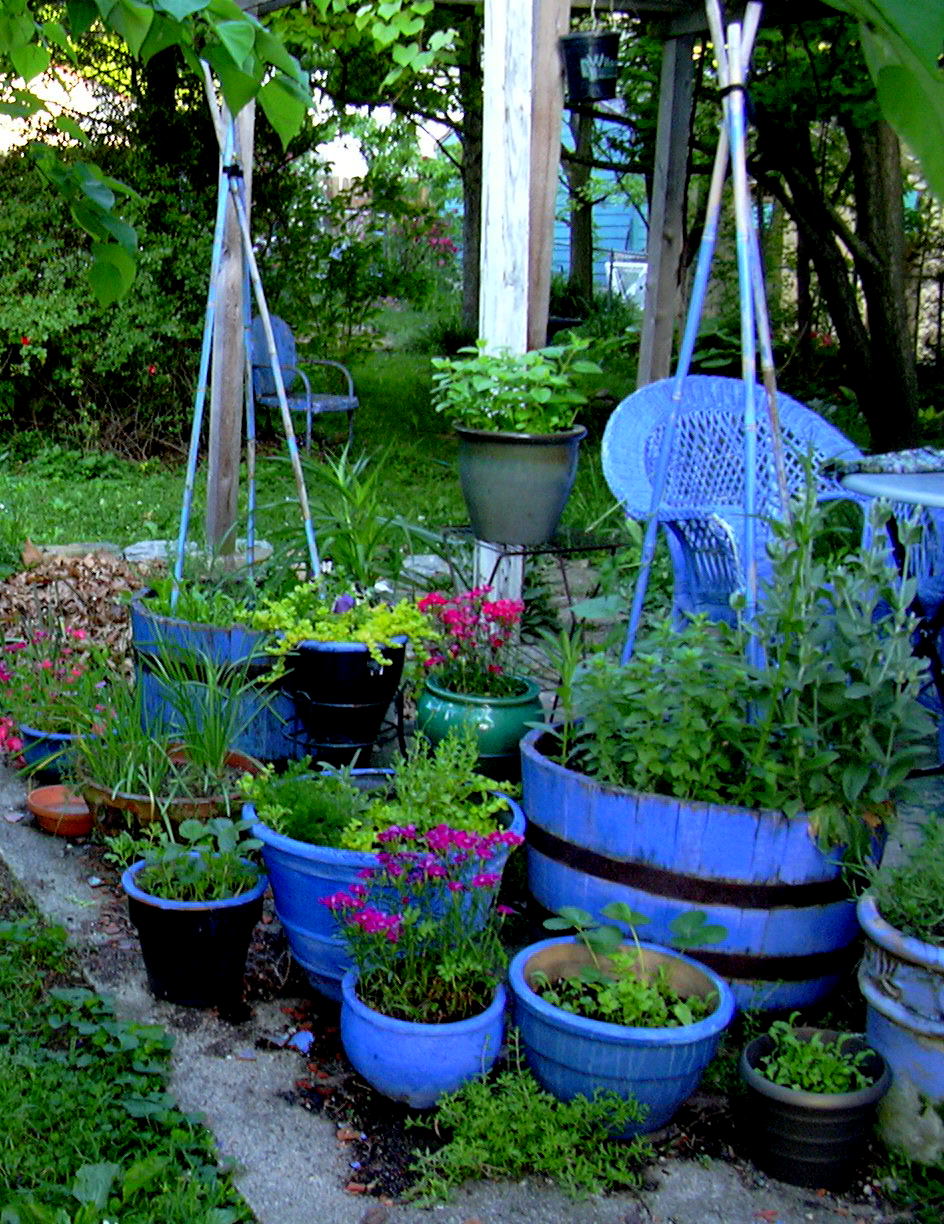
Maybe I was a Pict in a previous life.
Then, I discovered Jacques Majorelle.
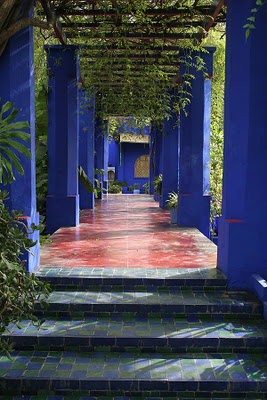
Photo by landscape designer Jan Johnsen from his blog http://serenityinthegarden.blogspot.com/2012/01/jacques-majorelle-and-his-blue-garden.html
Majorelle’s story is great. He was a painter, also the son of a famous painter, who had terrible health problems and moved to Marrakech, Marocco, in an effort basically not to die.

He created this garden in Marrakech.
He discovered the power of violet-blue.
He lived and gardened and painted in this place until he died at the age of 76.
Another one of my artist-heroes who did what I’m aiming to do: garden and do my art for a long, long, long time, till I drop dead. Preferably in the middle of a project.
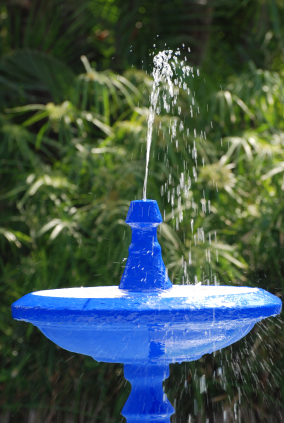
For more on Majorelle, check out Majorelle: A Moroccan Oasis by Claire de Virieu [photos], Pierre Berge [text] and Madison Cox [text] (Vendome Press 1999).
The nicest online photos of the garden are at Jan Johnsen’s blog, Serenity in the Garden.
The world owes a debt of thanks to Yves St. Laurent and Pierre Berge, his consort, who bought and restored this garden and opened it to the world. To tour it, see its link, JardinMajorelle.com.
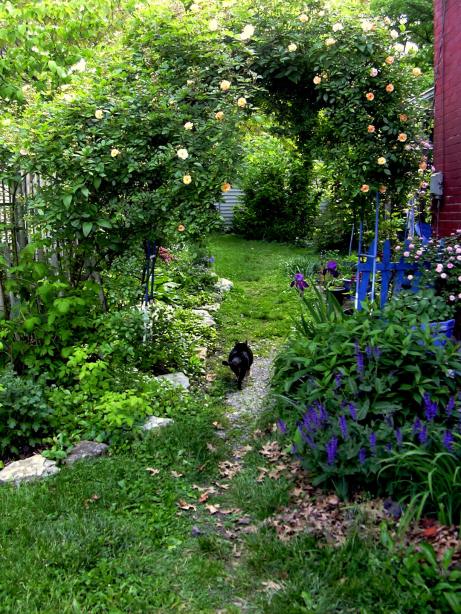
Here Lulu leads the way into the backyard. We got her from the Frankfort humane society in 1998, shortly after we bought the house.
Arches are some great bang for the buck for a lot of reasons:
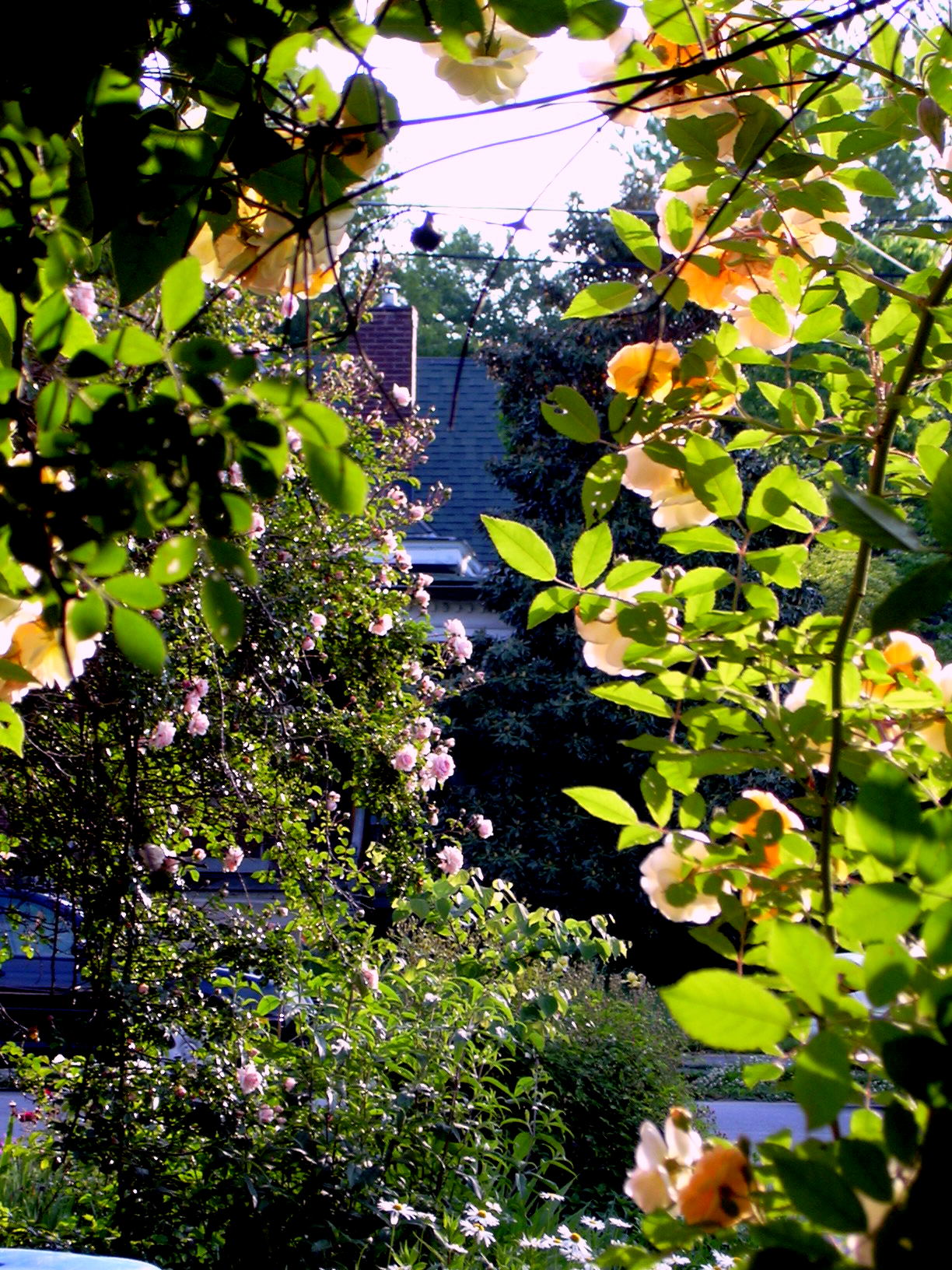
Looking back out through this same arch is also marvelous. The rose is Ghislaine de Feligonde. Kate Black started me this plant after I admired hers. Kate is an organic rose gardener who lives in Bell Court and also owns the house behind hers on Walton Avenue. She has achieved the gardener’s dream: when you run out of space in your own yard, just buy the house next door and keep going.
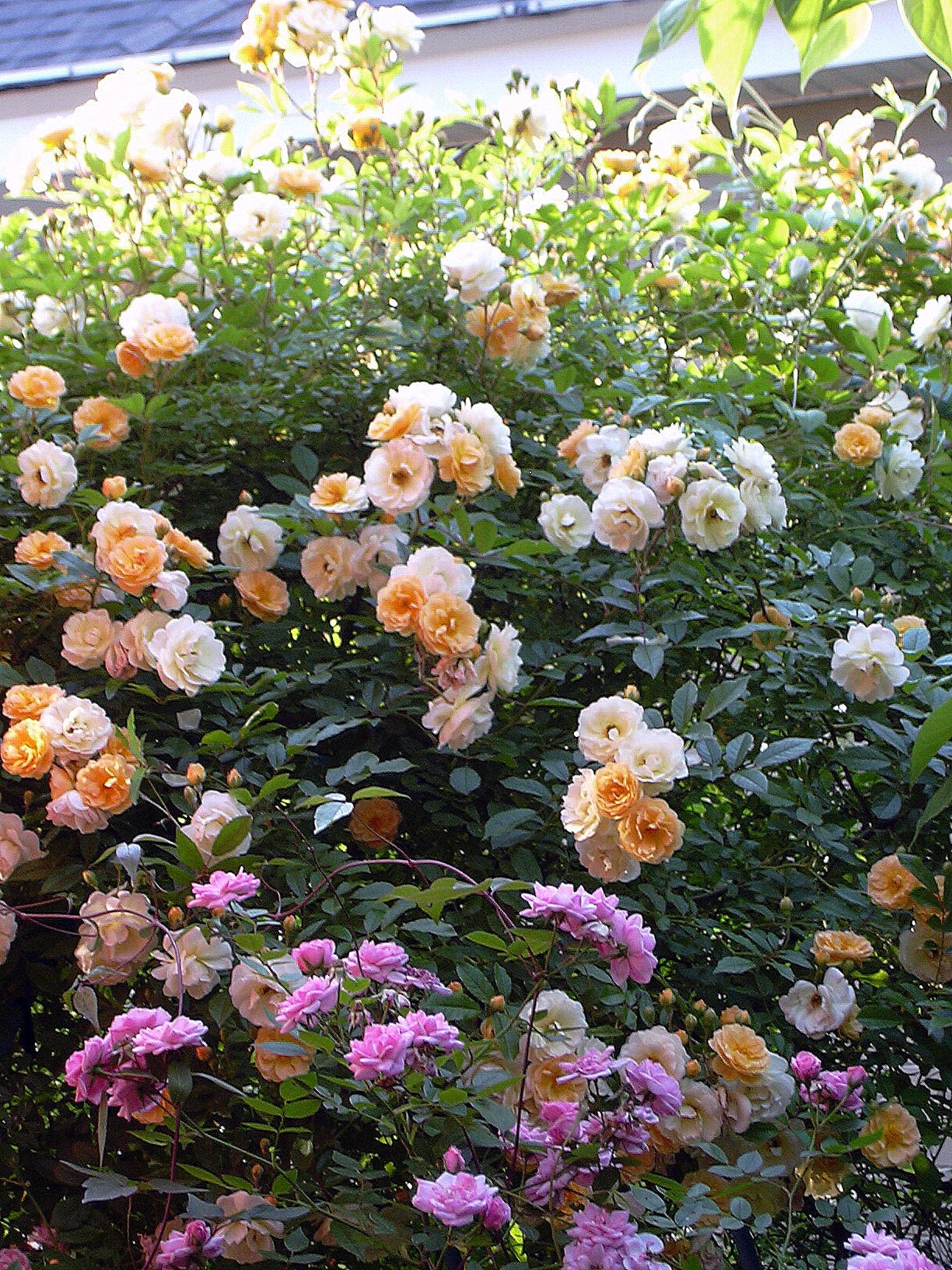
Here is another shot of Ghislaine, here with the pink miniature Jeanne La Joie, who has languished in a bourbon barrel for years. This winter/early spring, I will bust her out of prison and plant her in a spot with real dirt.
Here’s another arch, far into the backyard:
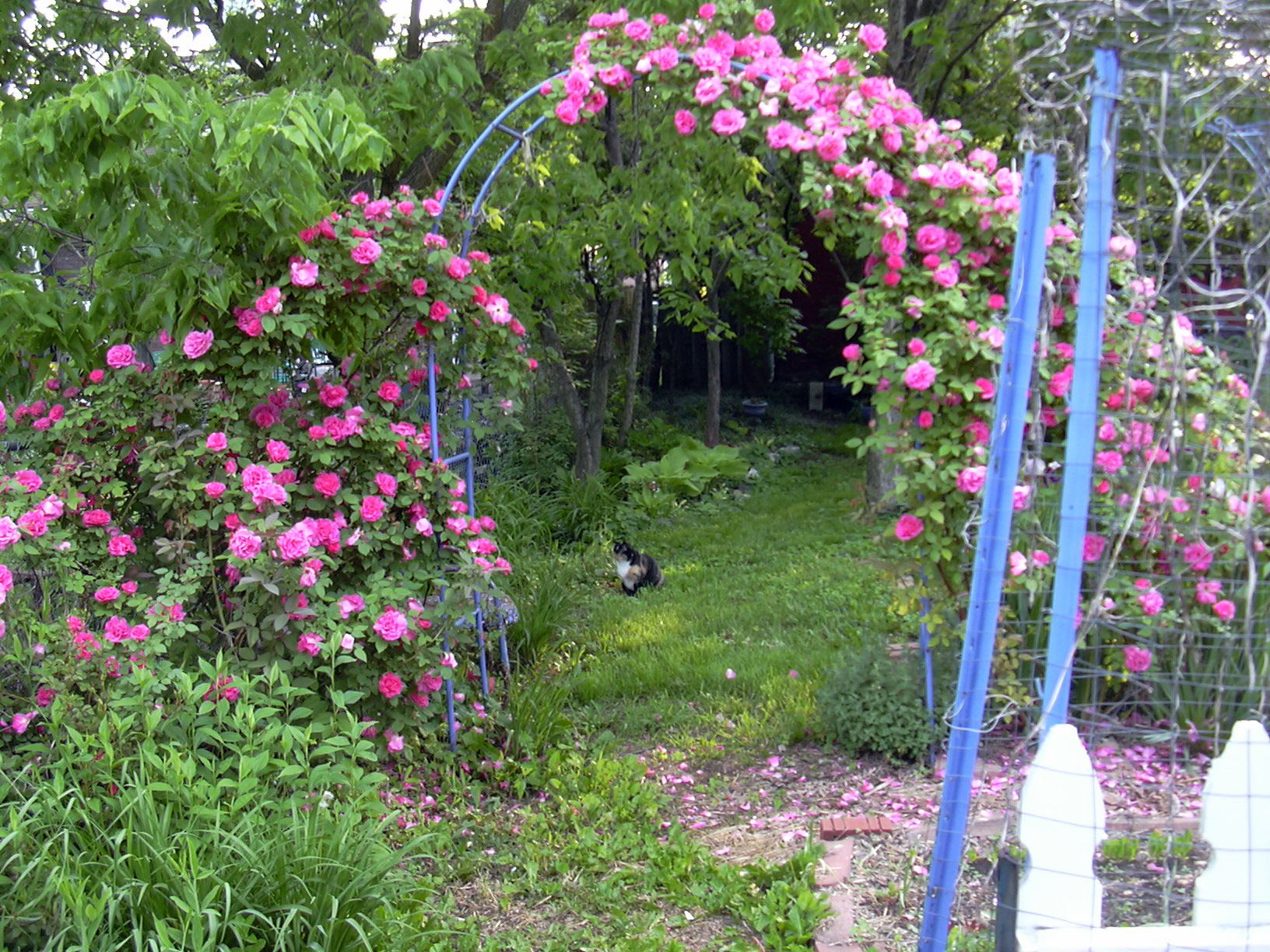
The rose here is Zephirine Drouhin, a thornless Bourbon climber. The cat is Teeny, who followed me and Bob home from a walk in July 2006.
I added this arch because I had started the plant on the left from the mother plant on the right, planning to give it away [I do spread the good news about roses at every opportunity] and the new plant had gotten too big to give away. I had to do something, so I got this arch and visually joined them. Much better.
I love this particular kind of arch: it’s about six feet wide and nine feet high, say seven and a half once installed. I get mine from Jackson and Perkins — their prices are high for most things, but I think these are still a bargain at a hundred dollars a pop. They are steel and VERY strong, last for years.
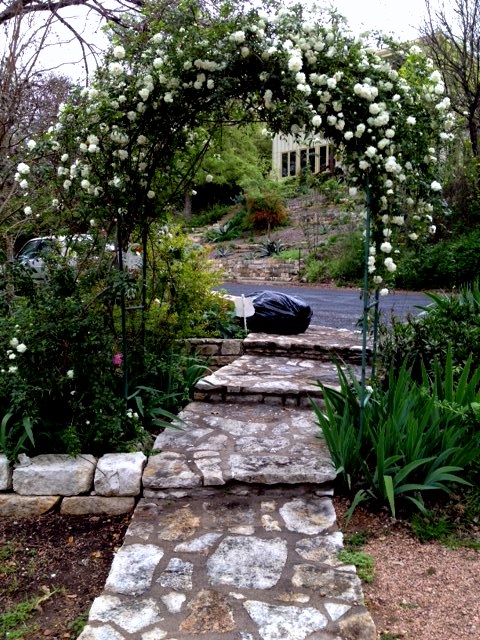
Arch in Austin, Texas, with Fortuniana, March 2012.
This arch is in Austin, Texas. My sister Kamilla has allowed me to colonize her yard with roses and irises from the old house that was going to be bulldozed. I wish I had another shot this arch in bloom. The black garbage bag in this one — well, I don’t have time for Photoshop, so here it is again.
I doubt that’s a body in the bag. They live in a nice neighborhood.
It does somehow interrupt the view of her front porch from the street, so that the porch and yard both feel more private and more inviting to sit on. They’re installing a fence to corral my niece somewhat, so I will I hope get updates on those structures in July or August when I visit her next.
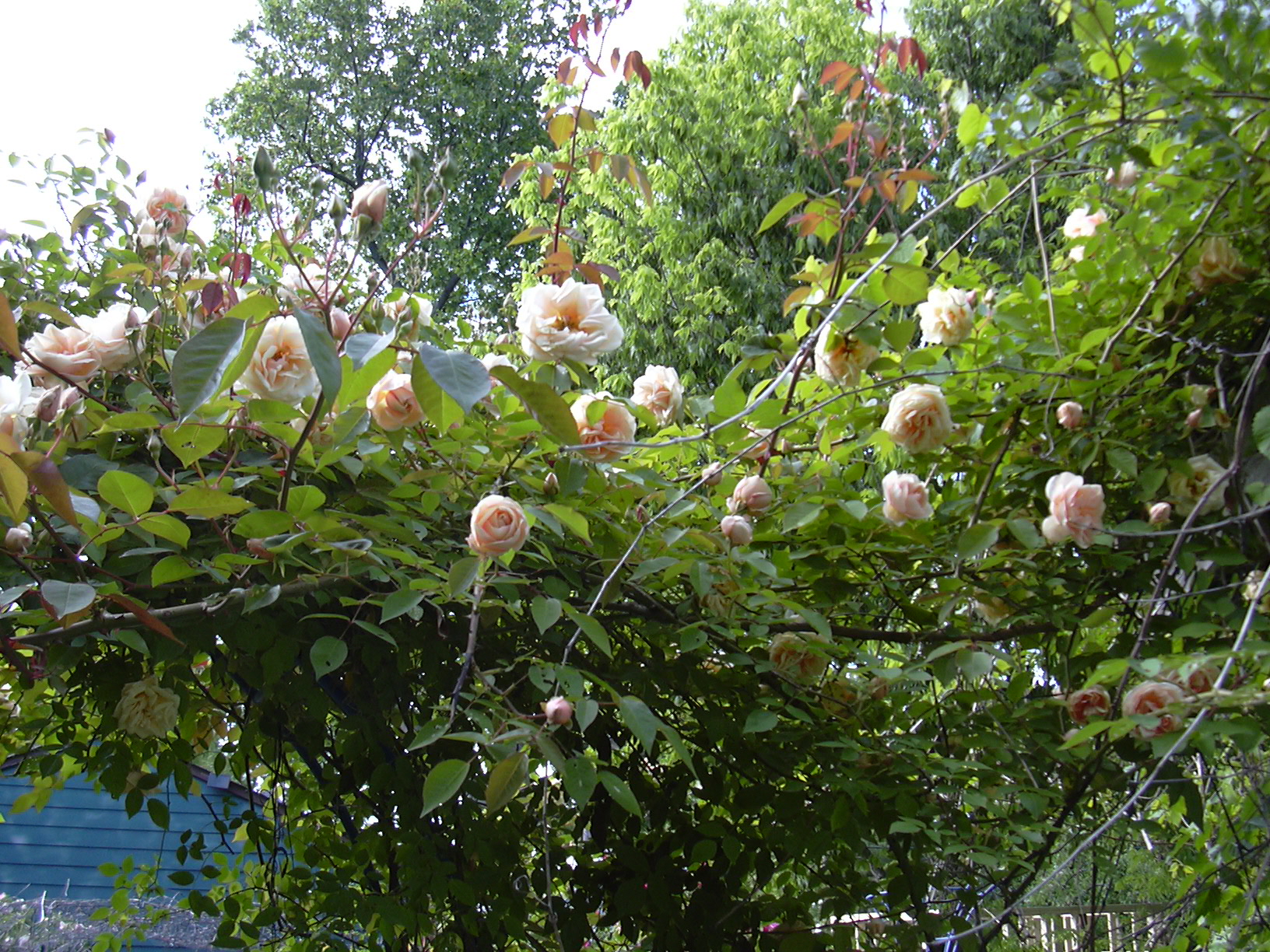
Back in Kentucky. Reve D’Or on the arch screens the compost pile, which is a thing of beauty to a gardener, except for its cinderblocks. This arch also has produced one brood of robins already this year.
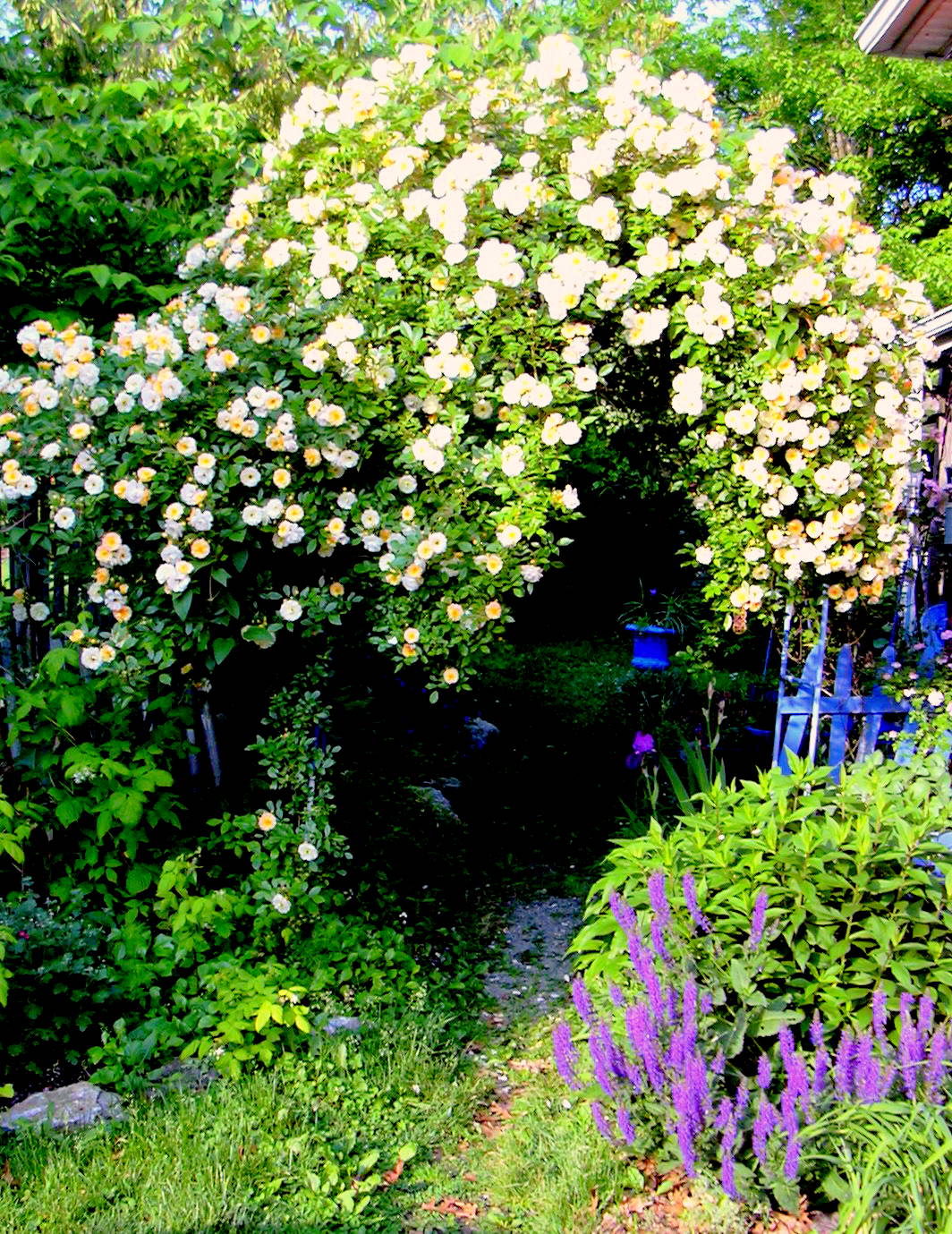
Structure is almost the most important thing in making a garden look good, and it’s where I fall short. Alas, the salary from my day job does not afford me fripperies such as brick or stone walls or paths, terracing, professionally-built arbors or patios.
So I’m on my own, and while my scale is limited, the process may be more fun that way. I can fake a few things, I have women friends who do not fear power tools, and I keep a crowbar and heavy gloves in the trunk of my car in case I’ve got to scavenge some rocks from a building site.
“Who, me? I just wanted a few rocks for my flowerbed.. . . ”
How much rock do you think an out-of-shape, middle-aged woman can “borrow” from a construction site?
I’ll show you later in this series.
Vertical structure:
The biggest bang for the buck comes from anything vertical: arches, trellises, pergolas, columns. Vertical elements allow you to create private space as well as to grow climbing roses and clematis.
Our 1905 house is actually the biggest structure in the garden, and that’s probably why I bought it: to garden around. Bob thinks we bought it to store books and guitars. The cats believe it is to give them a safe and comfortable place to sleep between meals.
Thinking of ur back porch as a garden structure, I can see that it creates the best place in the house and yard, a private garden room/home office/place to have coffee in the morning:
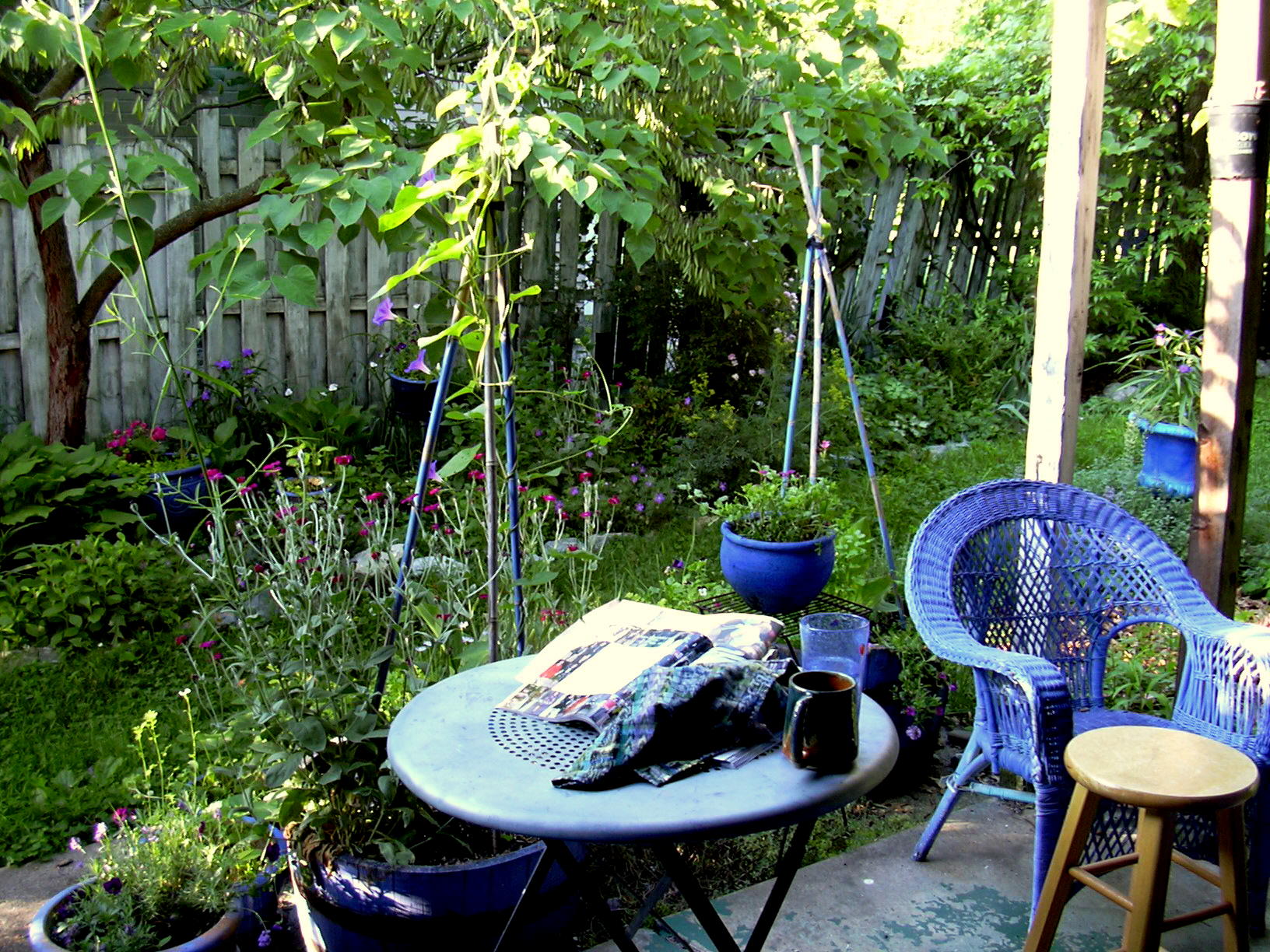
Looking through the kitchen door at the back porch.
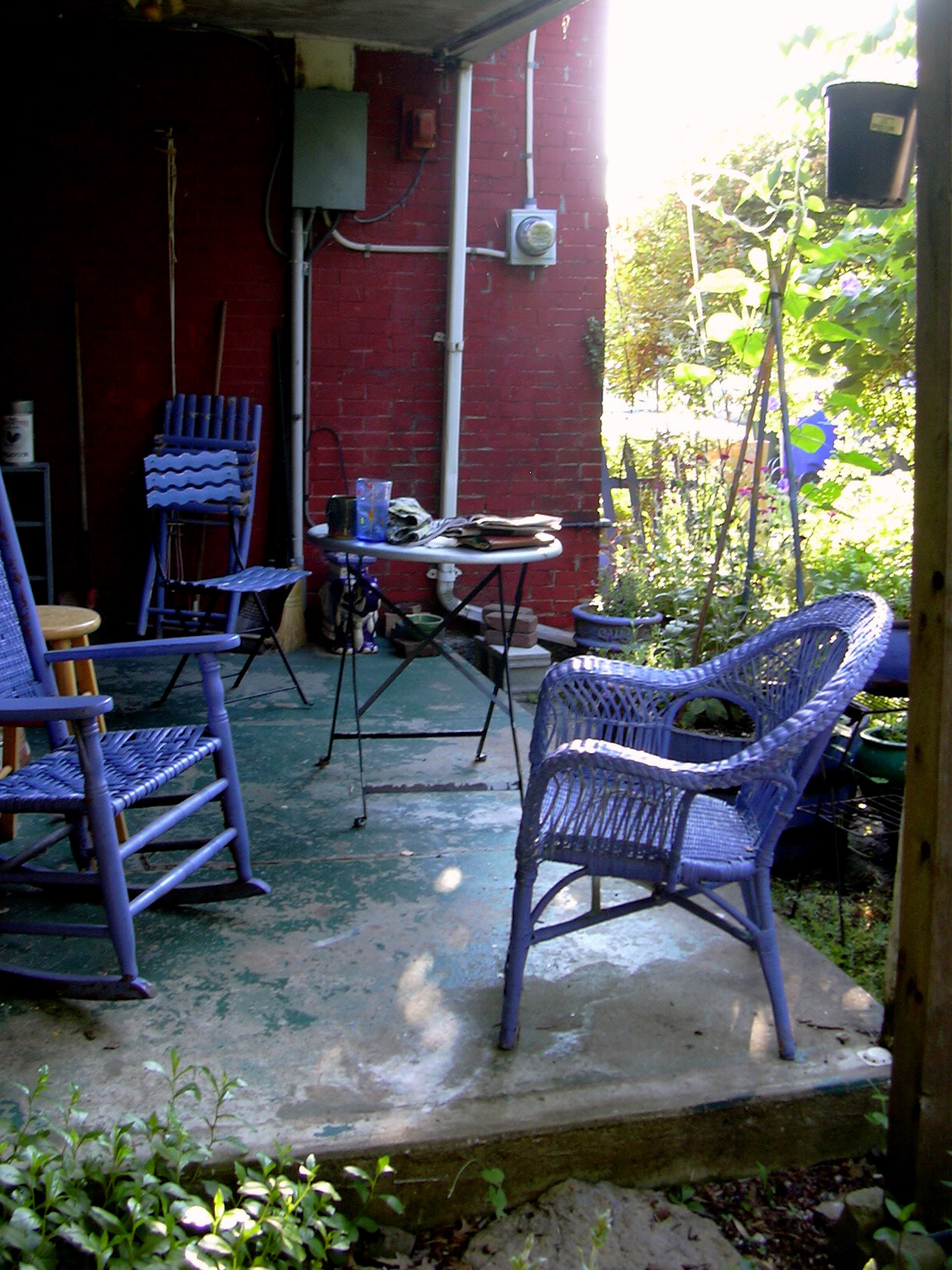
I live here summer mornings. It’s a great place to read, write, and drink coffee. The acoustics are not too bad for guitar playing when the neighbors’ A/C is not on. More often, I see some weed that needs killin’, and I’m shot out of a cannon into the yard for several hours.
From the backyard, it looks like this [Yeah, I don’t bother to style my photos — here it is, crap stacked against the wall and everything]:
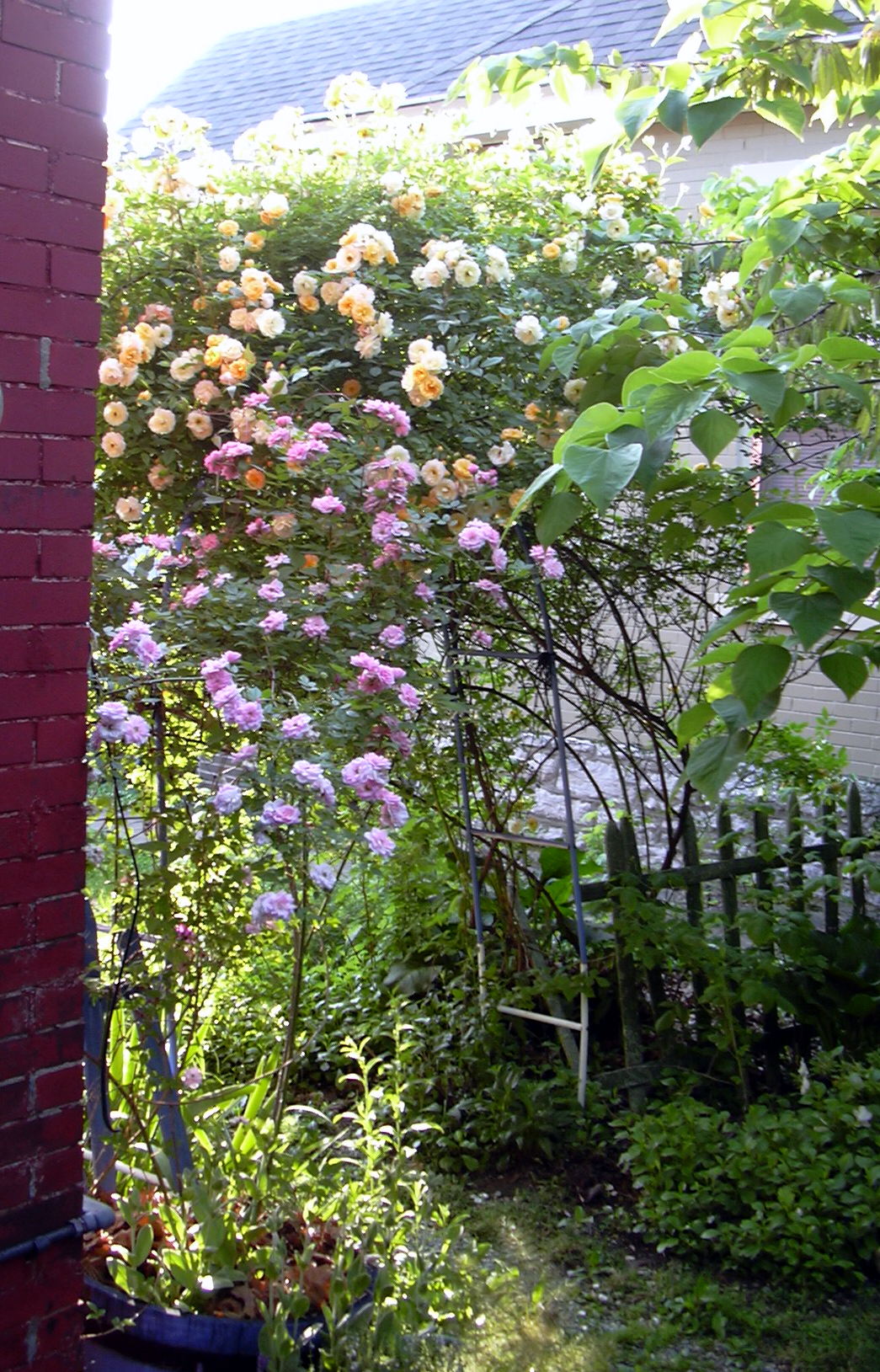
The view of the rose arch itself from the back porch when the sun is rising over the houses across the street is sometimes amazing. Awesome backlighting!
As far as the view from the porch, the neighbors’ rental property next door is maybe fifteen feet from the porch, but you can’t see it very well in this photo. Good!
We did some things to “interrupt the view” — a very apt term — from one of their windows that looks over the fence right at where I like to put my breakfast table.
I wanted to interrupt the view rather than create an unfriendly-feeling fence that walled the neighbors out and walled us in. Much better.
The photo below shows part of the relocated fence, the trellis, the redbud’s trunk, and the shade garden it makes possible, with hostas and ferns.
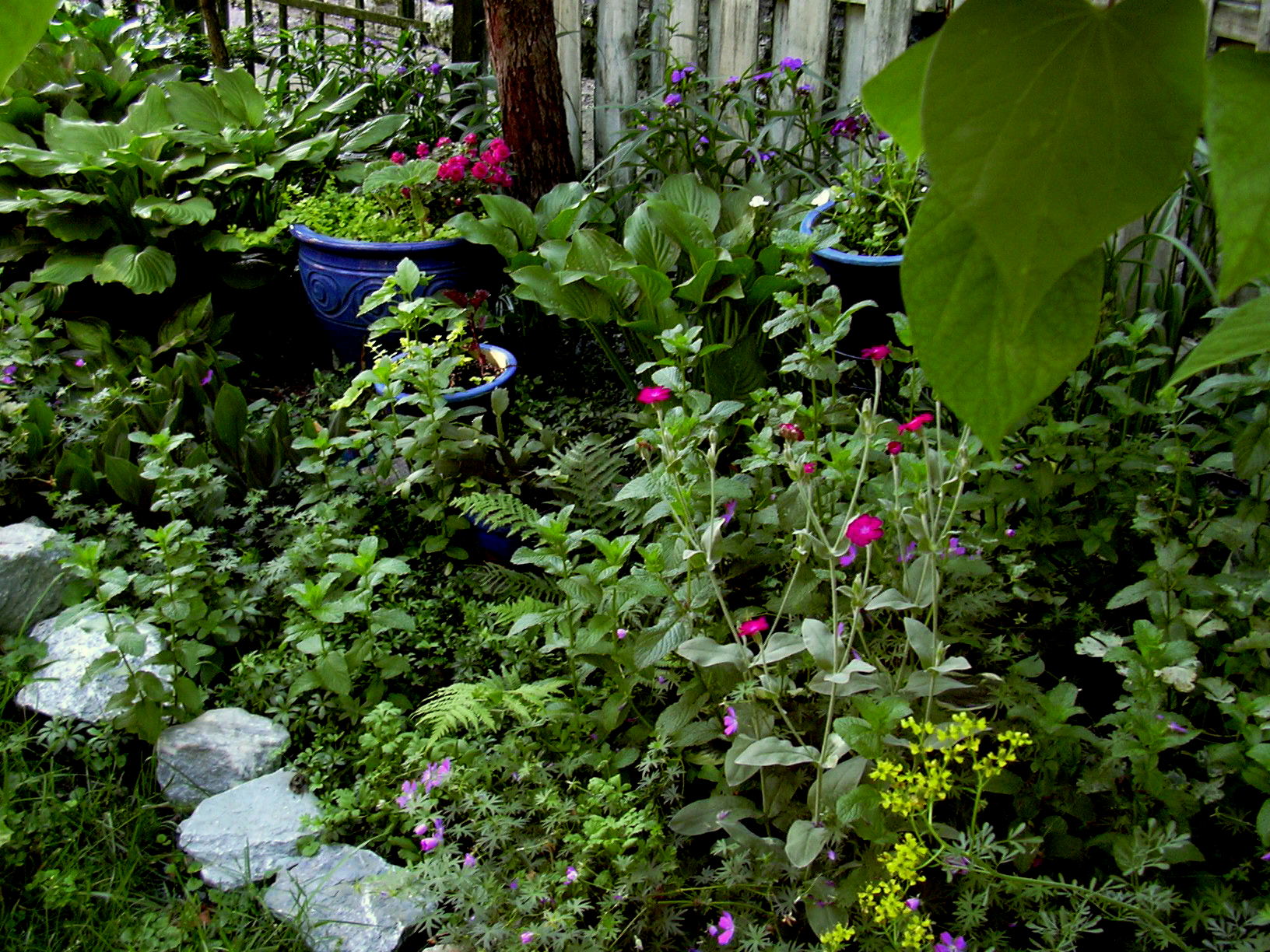
Note the rocks lining the flowerbed.
To come: More Structure: Front porch columns; Rocks [patio, front walk, flowerbeds, etc.]; Arches; The Hambrick Avenue Home for Decrepit Chairs; Pergolas and Girl Power Tools; Jacques Majorelle, Etc.https://lazyorganicrosegardener.com/structure/
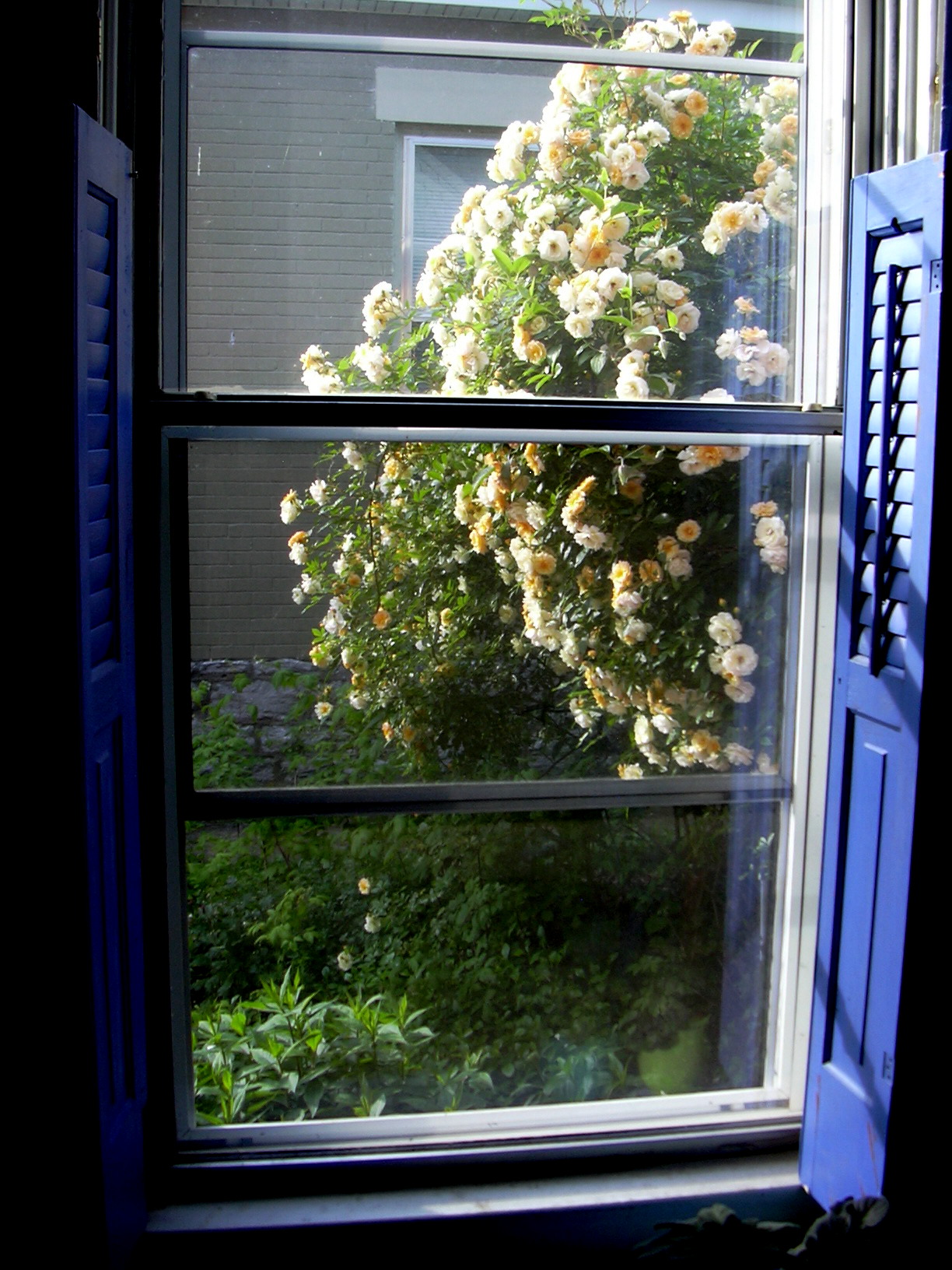
This spring we must have gotten the right weather at the right time, because everything bloomed wonderfully [if terrifyingly early]. Here are photos.
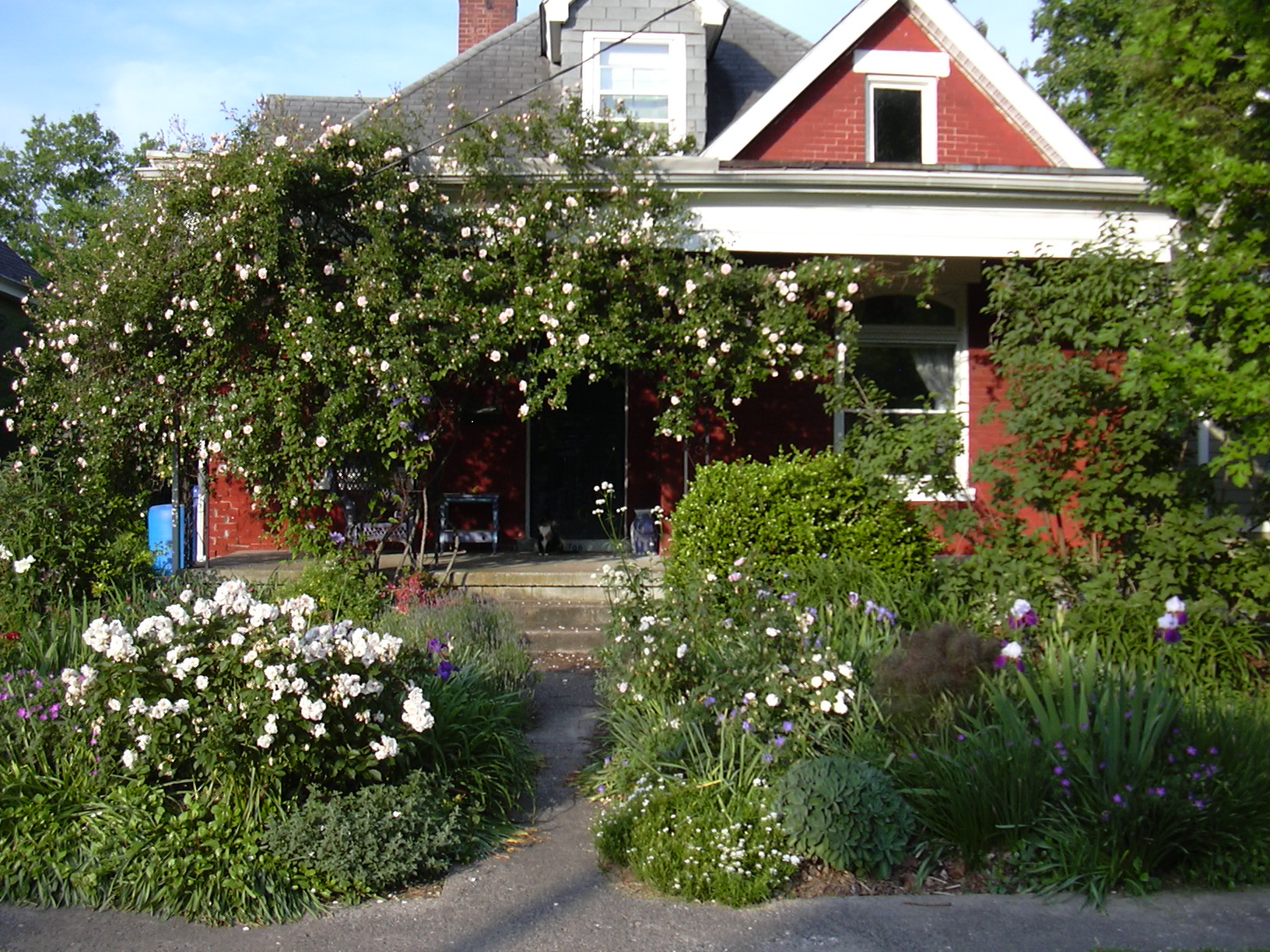
The big one trying to tear down the porch at left is Awakening. Bob said he saw a fireman driving by [without the siren on] whip his head around as he drove by. Is that a rose or WHAT?!!!
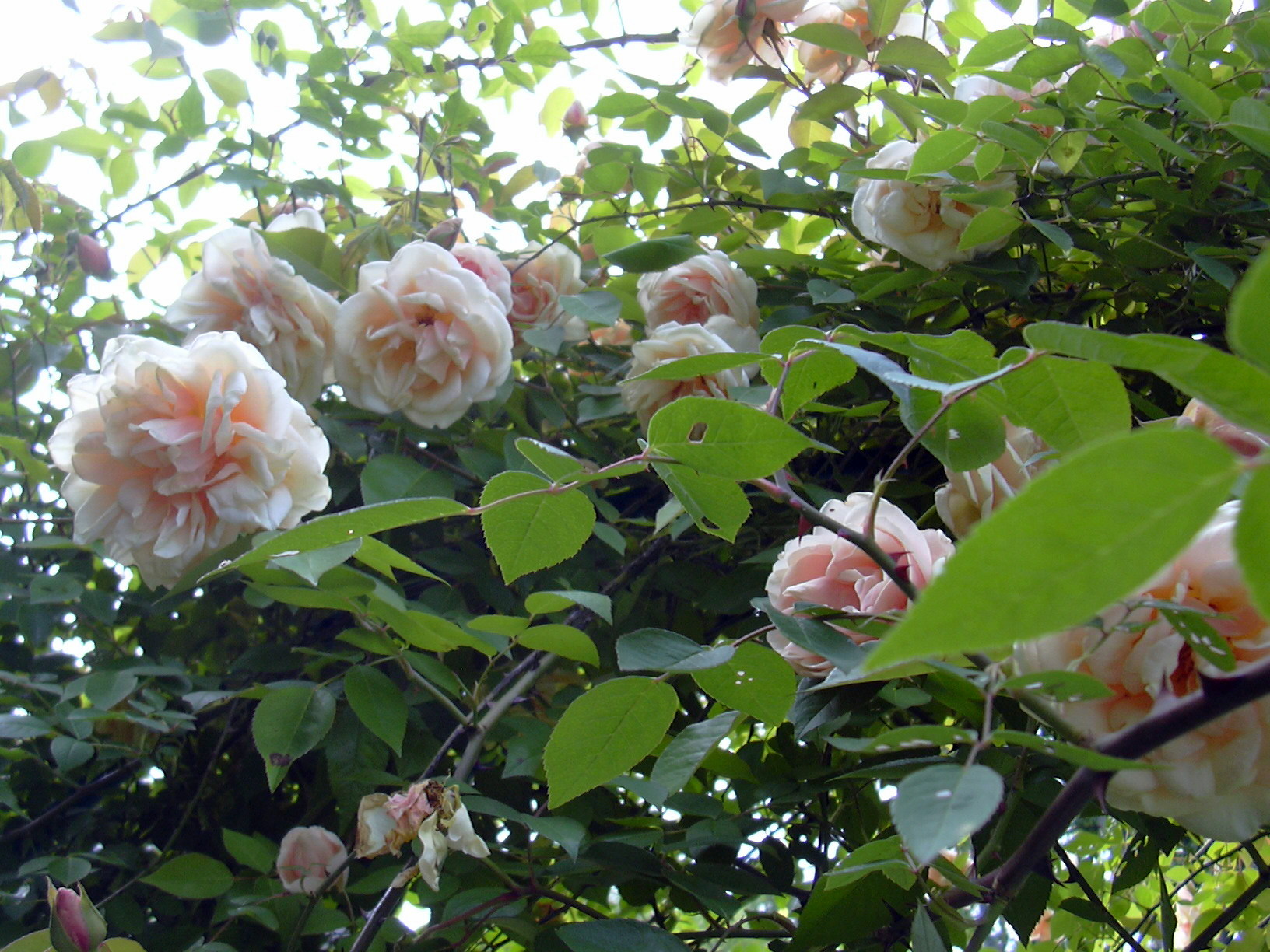
Reve D’Or looking down from arch next to the compost pile. This is such a great rose and has withstood much abuse. It’s so far from the house I didn’t supplemental water it at all as it was getting started, and it’s gotten so lovely.
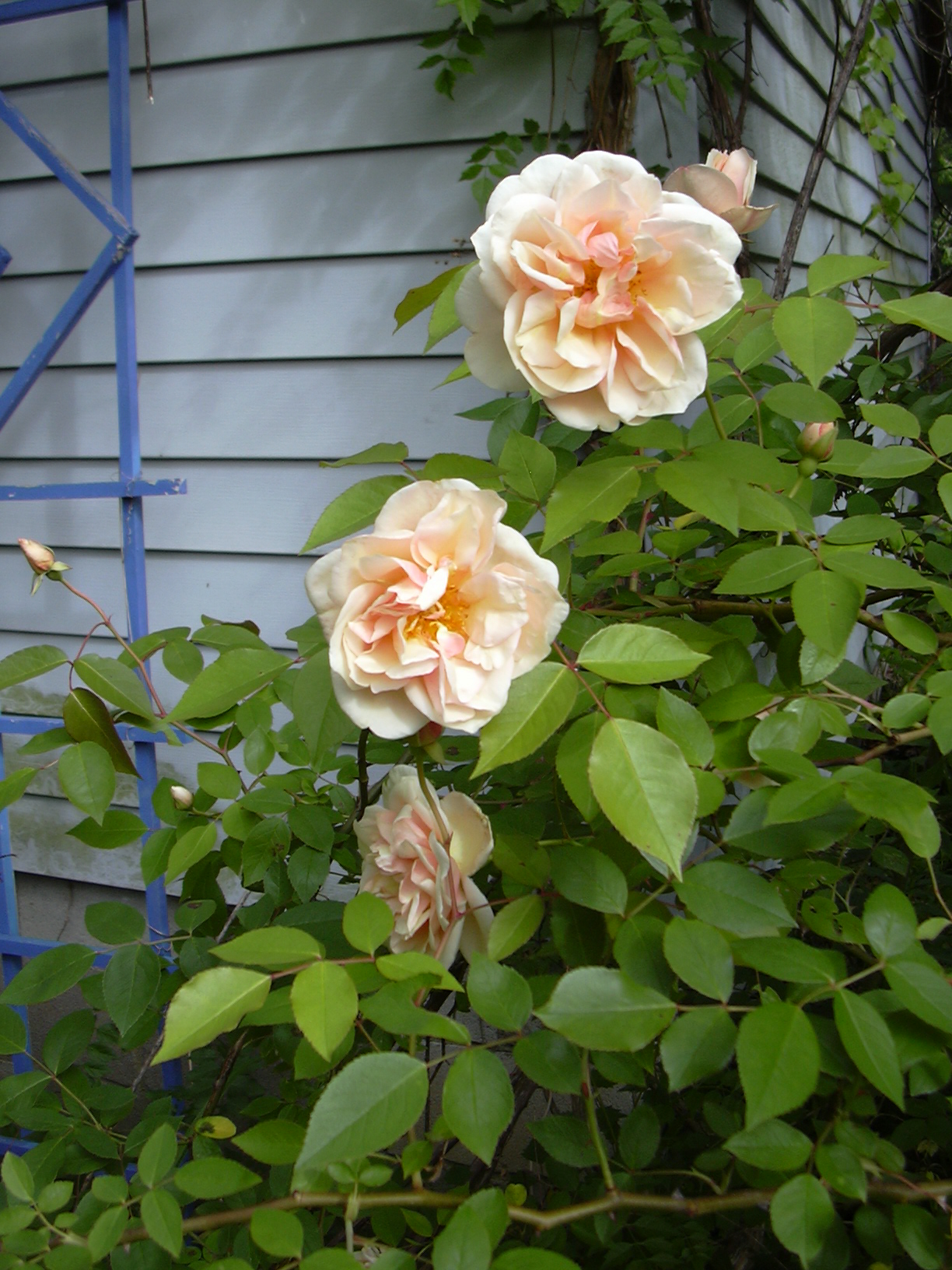
Here it is, close up.
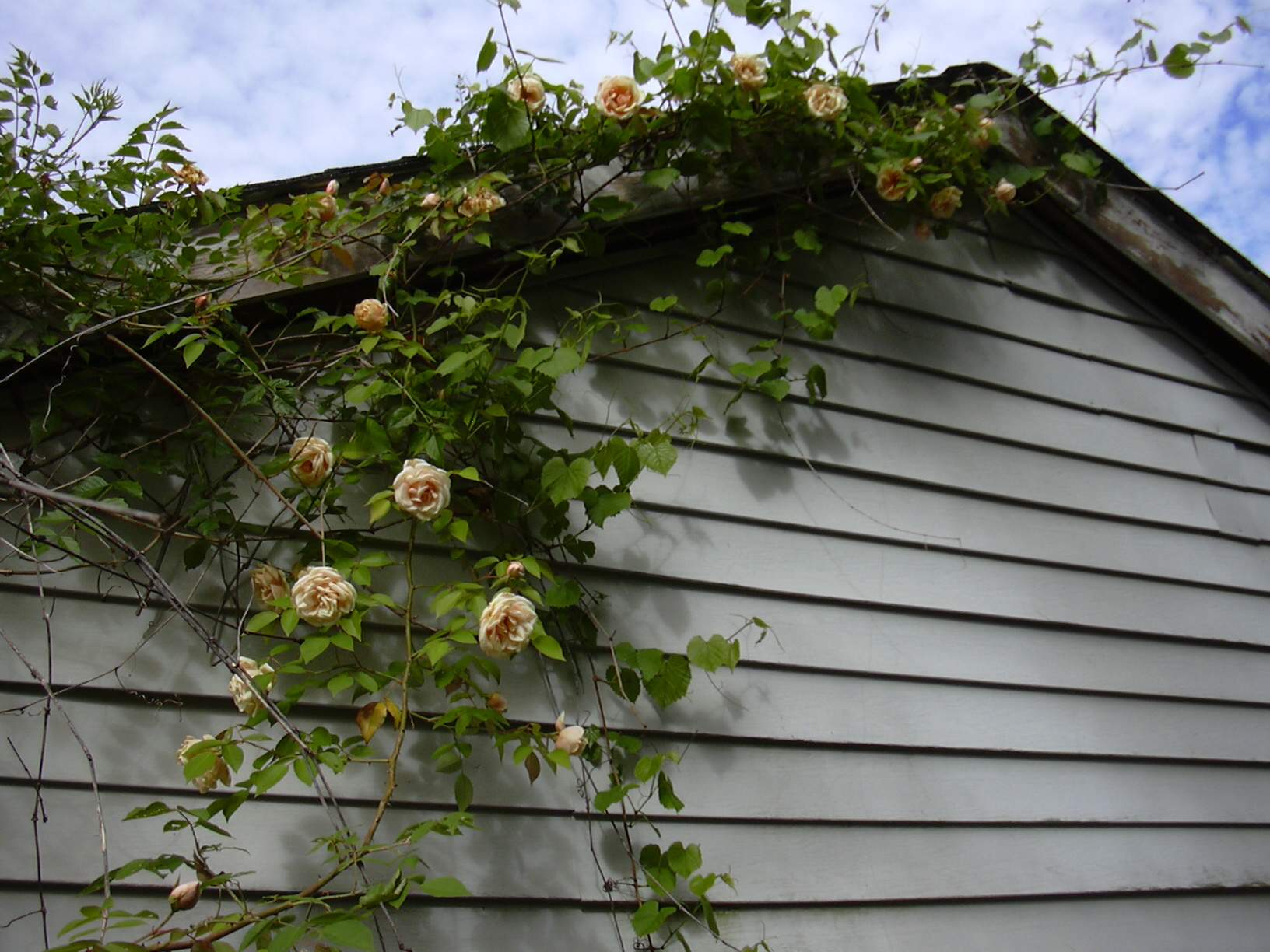
Scaling the garage wall with no encouragement from me. A wild grapevine got there first and provided a scaffold. Roses climb with their thorns, which usually point down toward the roots, except in one species I can’t recall just now.
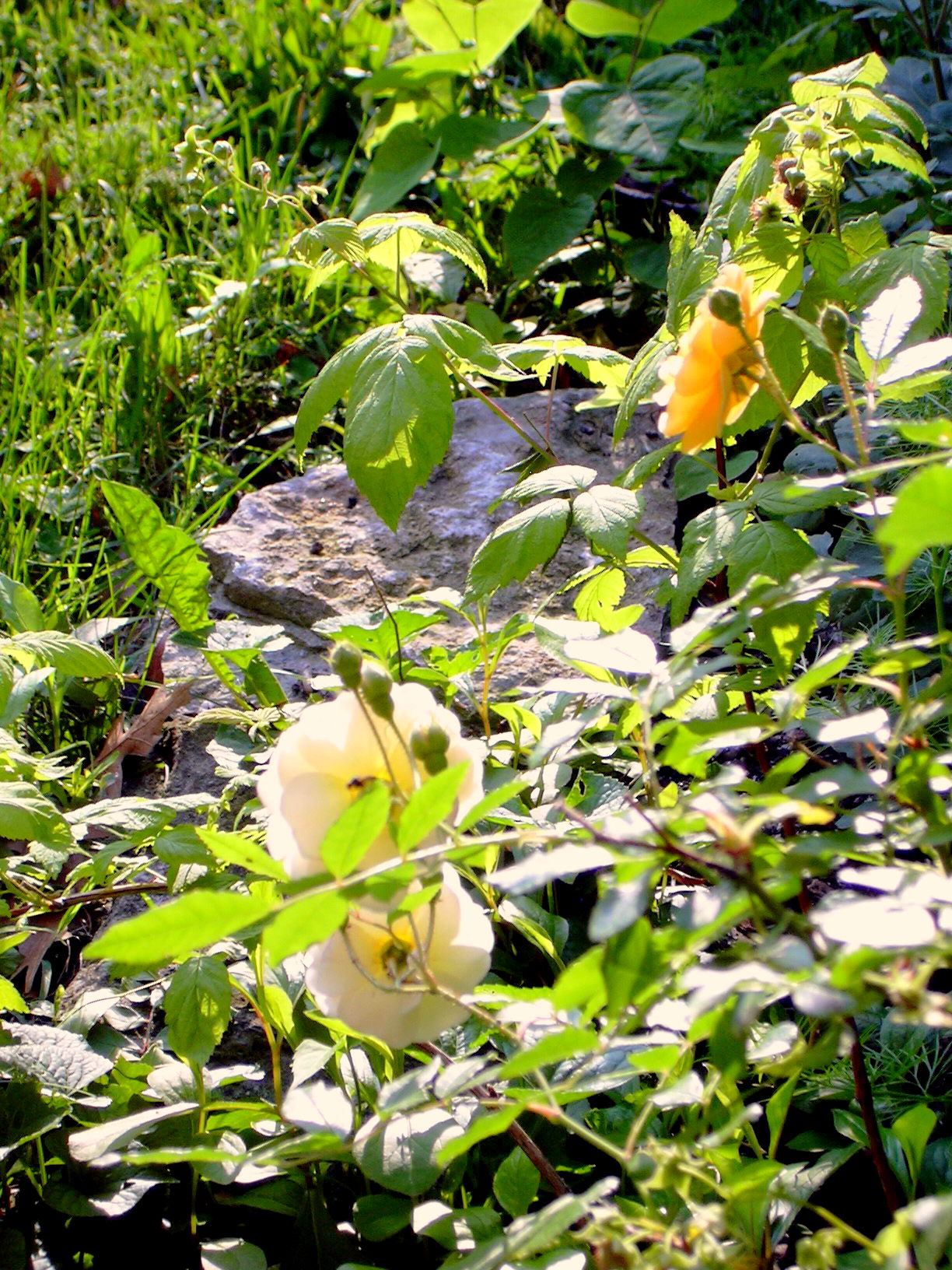
Not the same rose. This is Buff Beauty, climbing up an elm tree.
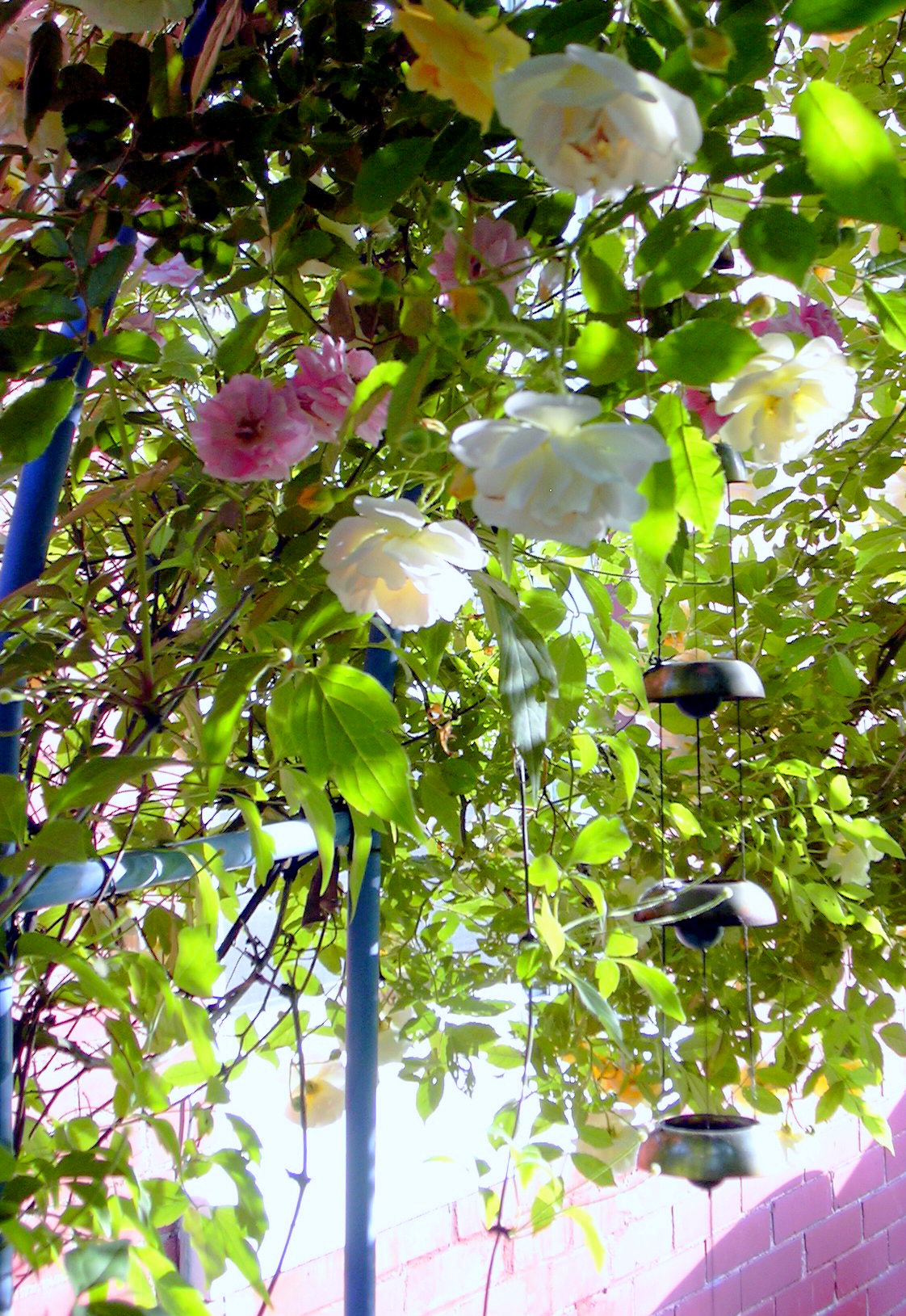
The arch to the backyard from underneath [with Ghislaine de Feligonde and Jeanne LaJoie].
Here’s the view from outside the arch:
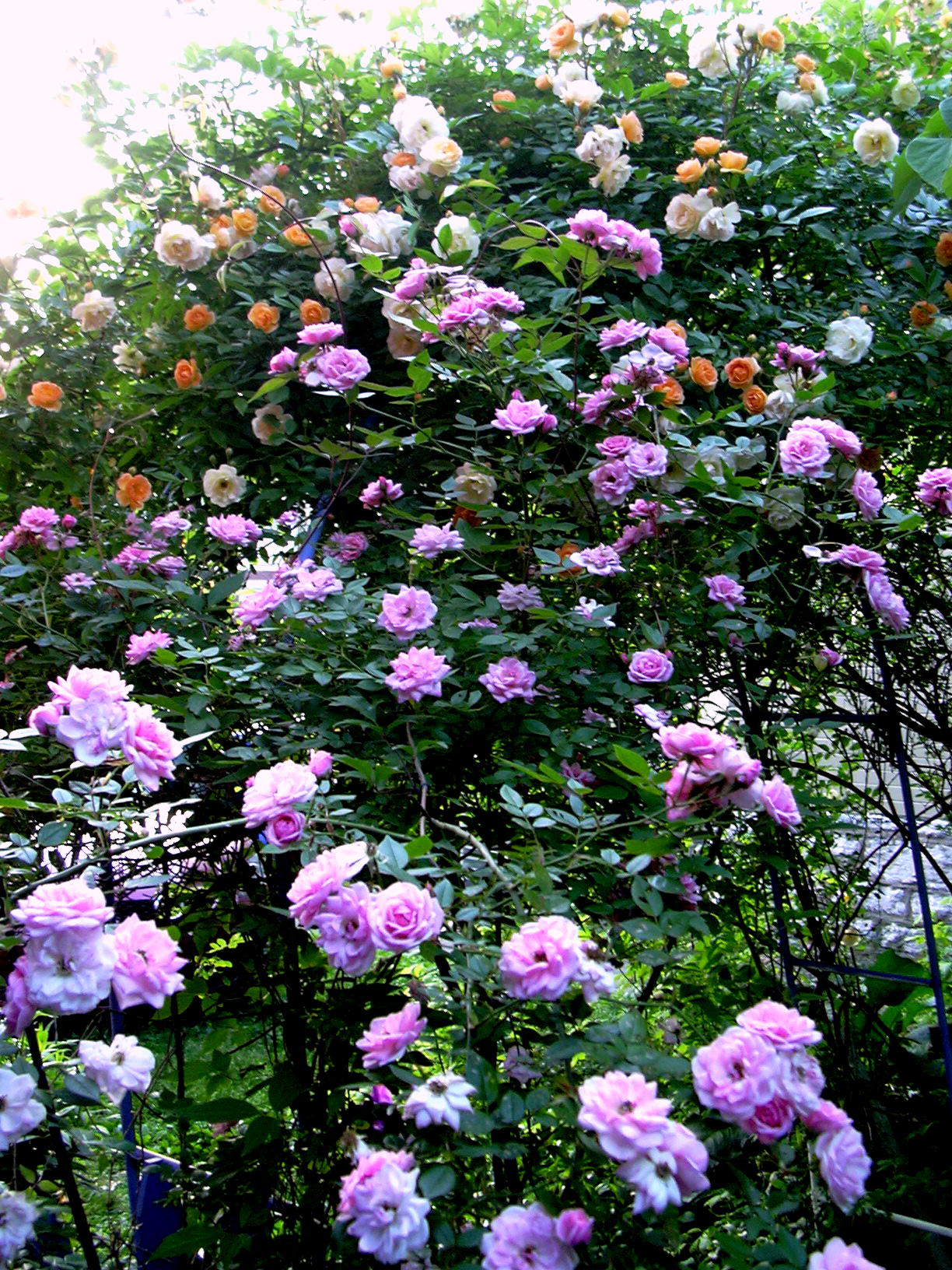
Another arch with roses:
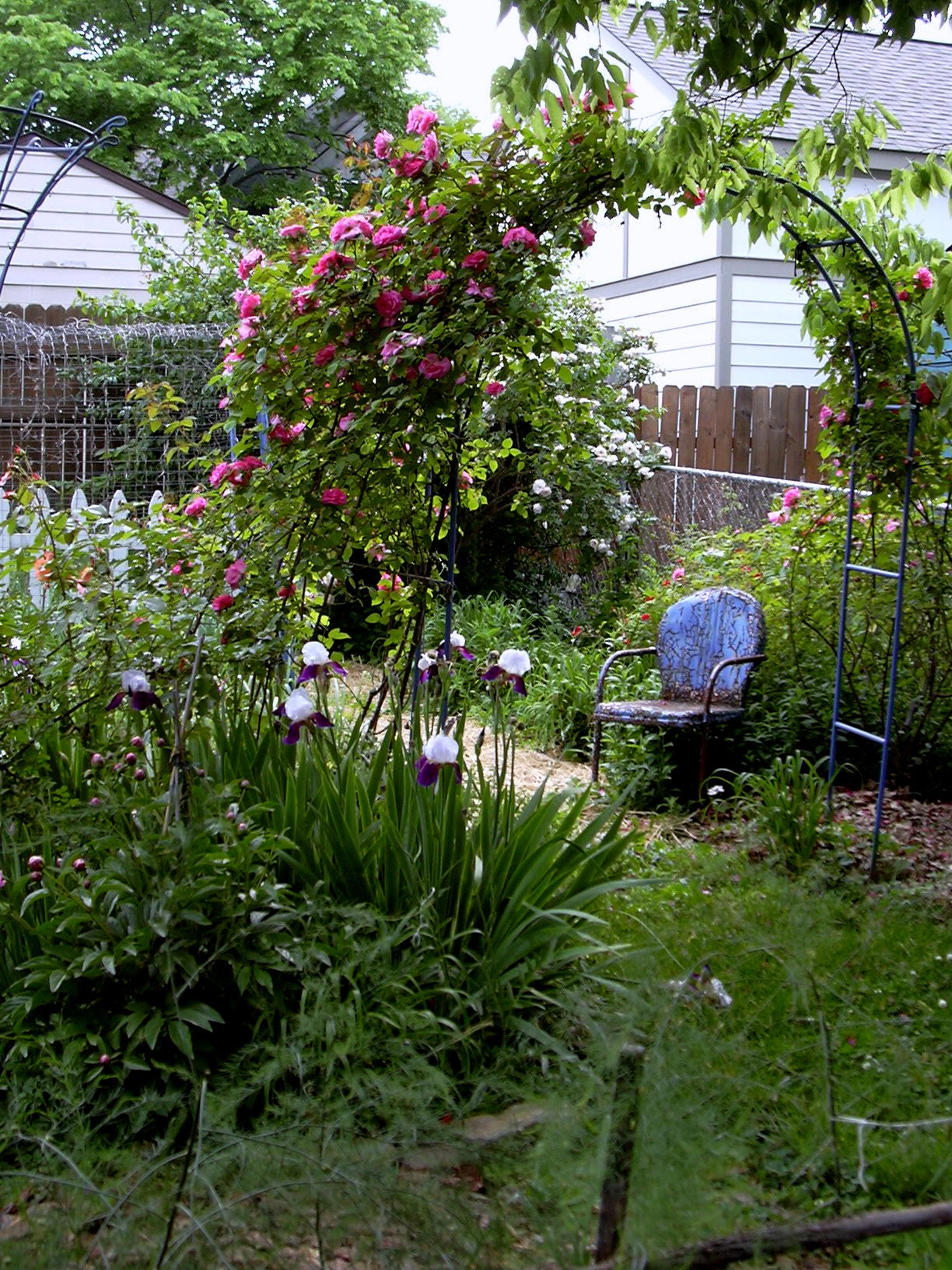
My sister Kamilla’s house in Austin, Texas, March 2012.
If you are lucky enough to live in Zone 7 or south, you can grow White Lady Banks [Rosa Banksiae] and Yellow Lady Banks, and this lovely: Rosa fortuniana. It’s thought to be a naturally occurring hybrid between white Lady Banks and Rosa setigera. It was discovered in China in 1850 by Robert Fortune, an enterprising Scotsman who traveled the world looking for new plants. [Many thanks to Antique Rose Emporium <www.antiqueroseemporium.com>, from whom I get all my information and most of my roses].
In Austin, all three of these lovelies grow like weeds. This one was probably planted two or three years before Kamilla took the picture. They bloom for several weeks in the spring with zillion-petaled two-inch flowers that have an old-school knot of petals at the center. They grow in sun or shade and don’t get black spot much or pout and lose their leaves during the dry part of the summer, which is saying a damn lot here in Austin. The Lady Banks roses have smaller half-inch flowers, tiny, really, but they produce thousands of them, so your plant looks like a fuzzy 12-foot-long pipe cleaner in white or a very lovely shade of primrose-yellow.
Oh, and they’re all thornless.
I found Kam’s Fortuniana mislabeled as White Lady Banks at a local nursery and planted it on the arch along with Climbing Pinkie, which blooms and re-blooms later in the summer. If it were my own house, I’d probably set some clematis to grow up the other side, because it plays well with climbing roses.
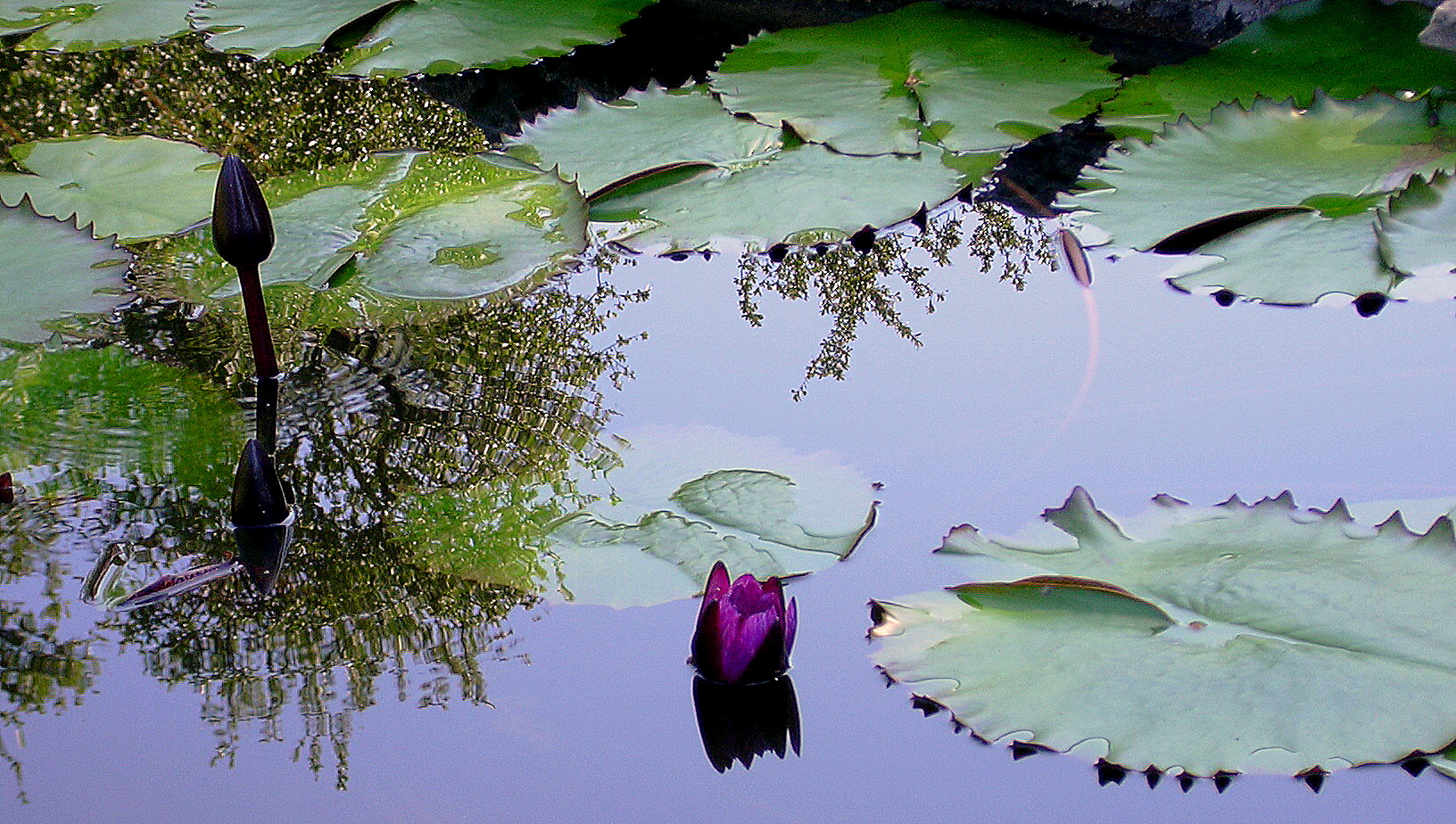
Austin Botanical Garden, Zilker Park, Austin, Texas, May 2012.
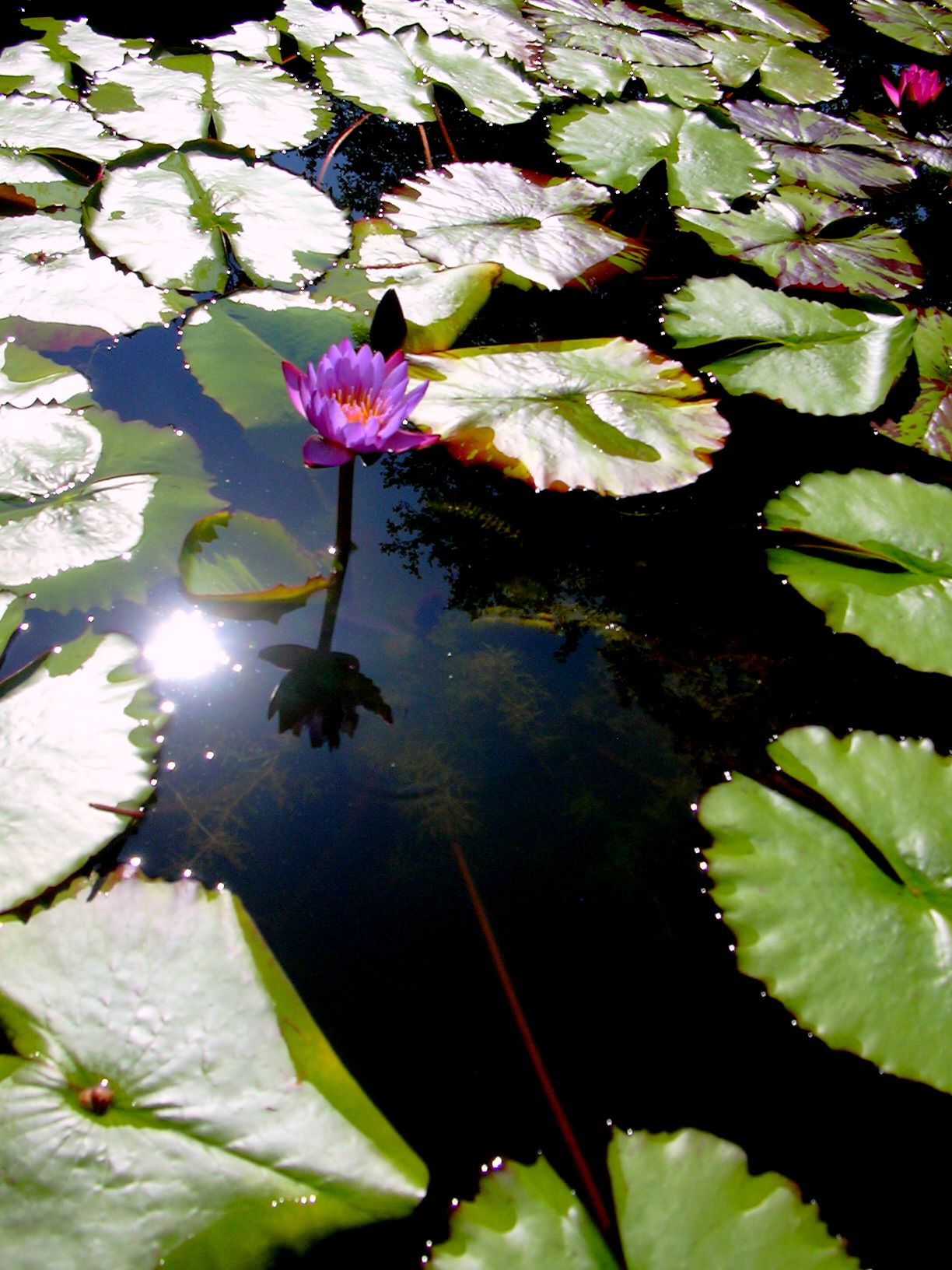
I know nothing about growing waterlilies, but I got some good pictures of some at Austin’s Botanical Garden at Zilker Park in Austin, Texas.
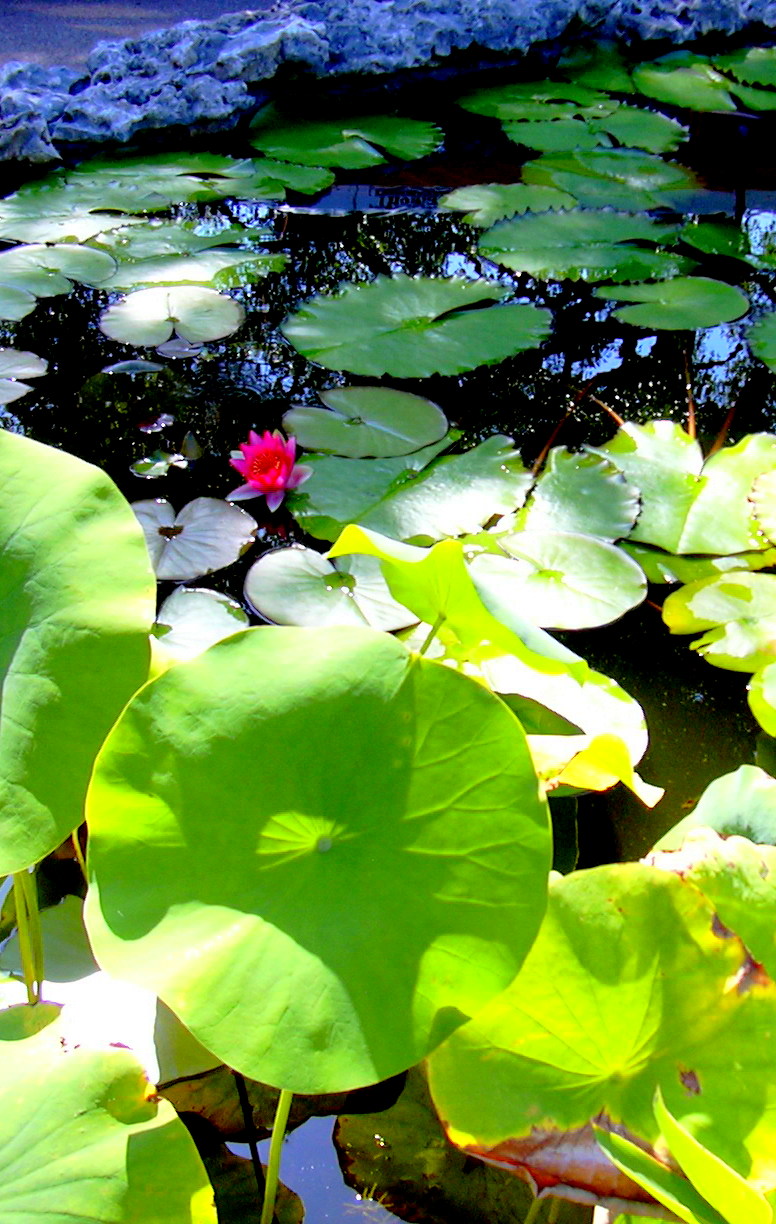
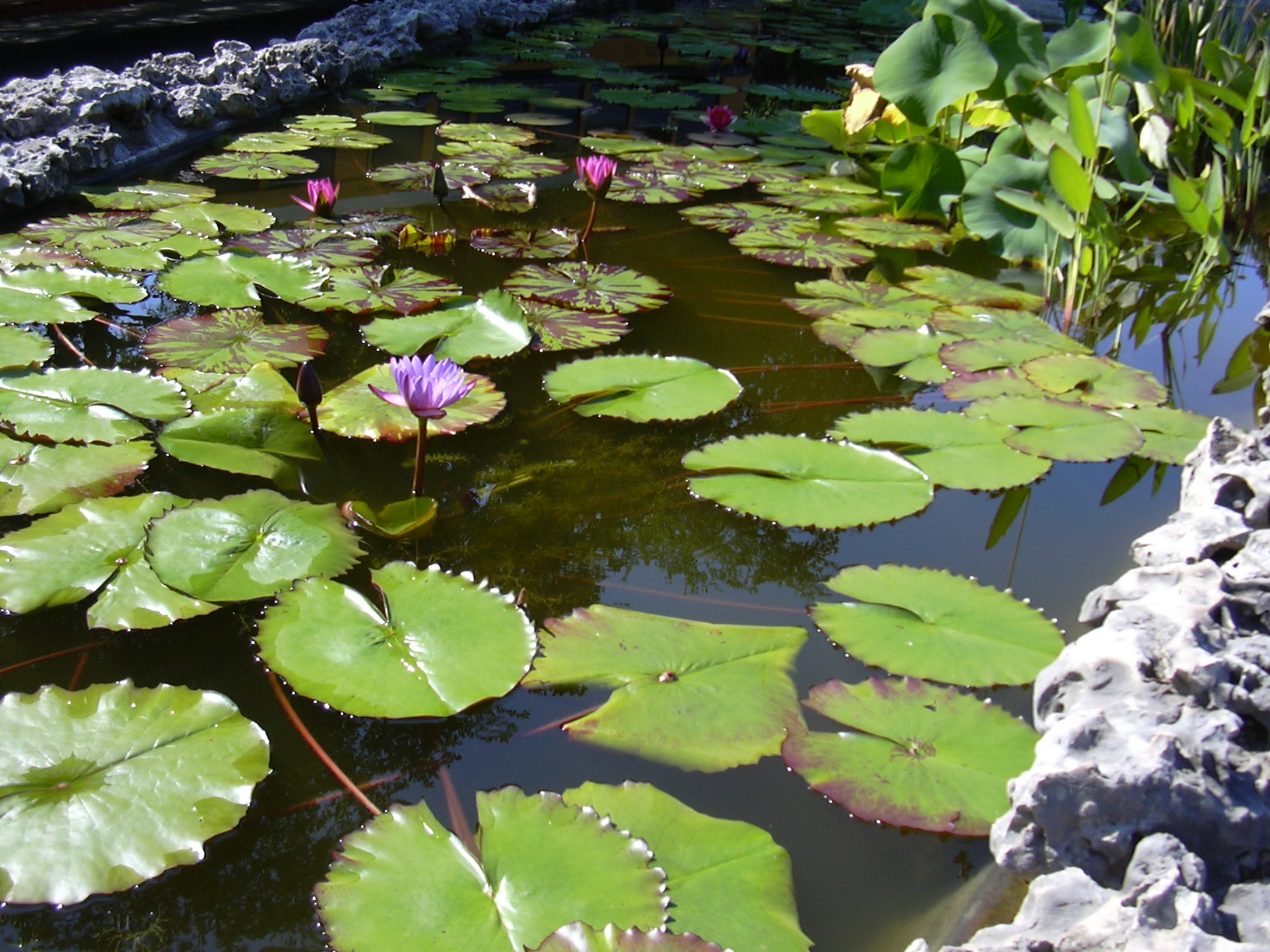
 16 June 2009
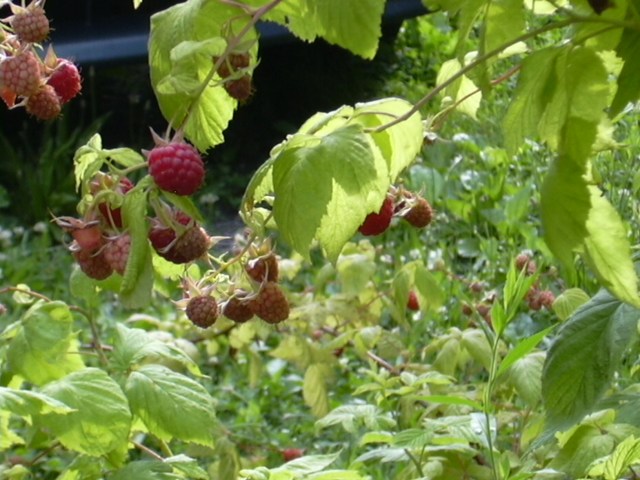
When I first started growing raspberries, I invariably picked them when they were bright red and full-sized, but not at full flavor: still a little sour. Over time, by tasting hundreds of them, I learned to tell when the berries were truly ripe and ready to be eaten.
The difference revealed that some of the assumptions about ripeness I had absorbed from the American t.v. culture of the 60’s were just wrong. At first, the truth about ripeness was counterintuitive to me.
When raspberries get ripe, their color changes from a clear, bright, raspberry-red to a dull, rich raspberry-purple. Not blackberry-purple, or even black raspberry-purple, but a shade that adds to the raspberry red some of the blue in a glass of merlot.
Far from being more obvious and eye-catching on the bush, they become something that you have to look for and learn to find. The berries that are first reddening are the brightest fire-engine red and attract the eye most. On a ripe berry, the shininess of the skins, produced by the fruits’ being swelled ever more and more by juice, dulls to a blueish bloom like the bloom on a plum.
These berries also are invariably the heaviest, so they hang the lowest and are the most obscured by foliage and the other berries on the cluster. There is a weight to a perfectly ripe berry that makes it the lowest-hanging one on the cluster. In fact, I’ve learned to recognize them by feeling for them beneath a cluster of ripening berries. At peak ripeness, they become heaviest and strain the suspension arc of the cluster and the individual berry stems that keeps the flowers upright and then bends lower and lower as the berries get heavier.
When a berry is perfectly ripe, you can see the band of white around the top of the berry as it releases its grip on the white core of the drupe. You don’t have to tug on it at all to get it off the plant. It wants to jump off into your hand.
More proof that we were made of, and for, the earth, and the earth loves us: I am my Beloved’s and my Beloved is mine.
 The Lazy Organic Rose Gardener